
Why Material Choice Matters for Underground Fuel Piping
Selecting the right piping material for underground fuel storage and dispensing systems is one of the most consequential decisions a gas station owner or contractor can make. The choice directly impacts long-term operational safety, environmental compliance, maintenance costs, and service life. While traditional steel piping has dominated the market for decades, underground composite pipes have emerged as a technologically superior alternative that addresses the fundamental weaknesses of metal systems.
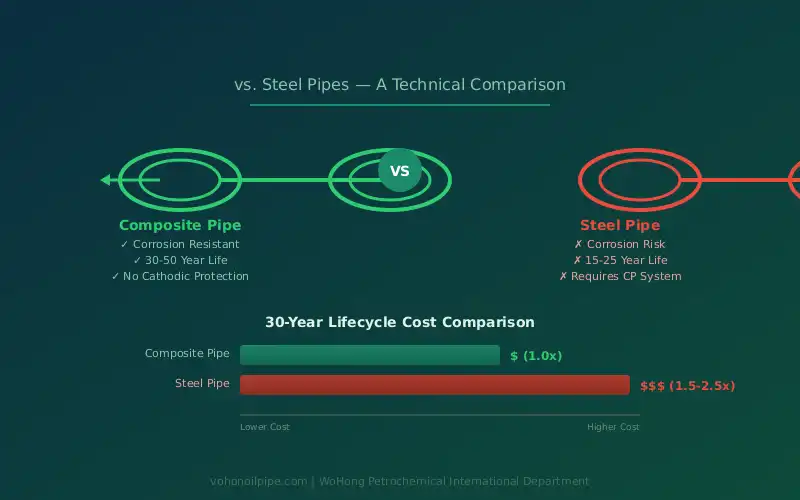
To make an informed procurement decision, buyers must understand how these two material categories compare across the metrics that matter most: corrosion resistance, leak integrity, installation complexity, lifecycle cost, and regulatory compliance. This guide provides a head-to-head technical comparison to support that evaluation.
Corrosion Resistance: The Decisive Advantage of Composites
Corrosion is the single greatest threat to underground steel piping. Soil chemistry, moisture content, stray electrical currents, and microbial activity all contribute to gradual metal degradation. Even with external coatings and cathodic protection systems, steel pipes in underground fuel service typically develop pitting or galvanic corrosion within 8-12 years, depending on site conditions.
Underground composite pipes, by contrast, are inherently corrosion-proof. The fiberglass-reinforced thermosetting resin structure is chemically inert to hydrocarbons, soil electrolytes, and aggressive groundwater. No coating system, sacrificial anode, or impressed current is required to maintain integrity. The corrosion resistance is not an add-on feature—it is a fundamental material property that lasts the entire service life of the pipe.
Real-World Implications
For a gas station operator, corrosion resistance translates directly into reliability. A corroded steel pipe that develops a pinhole leak can release thousands of liters of fuel into the surrounding soil before detection, triggering expensive remediation, regulatory fines, and potential third-party liability. Composite pipes eliminate this risk vector entirely.
Leak Prevention and Double-Wall Design
Both steel and composite underground piping systems are available in single-wall and double-wall configurations, but the practical leak prevention performance differs significantly. Double-wall composite pipes are manufactured as an integral structure, with the inner and outer walls bonded during the forming process. This monolithic construction ensures uniform wall thickness, consistent mechanical properties, and no weak points at joints.
Steel double-wall systems, on the other hand, typically consist of an inner steel pipe inserted into an outer steel or polyethylene sleeve. The annular space between the two walls is subject to condensation, debris accumulation, and differential thermal expansion, all of which can compromise interstitial monitoring reliability.
Composite pipes also offer superior permeation resistance. Hydrocarbon molecules have been shown to permeate through certain plastic piping materials over time, but the glass-fiber matrix in high-grade composite fuel piping effectively blocks molecular migration, preserving fuel quality and preventing vapor escape into the soil.
Installation: Speed, Labor, and Equipment
Installation cost and complexity often tip the scale in material selection, especially for retrofit projects at existing operating stations where downtime must be minimized.
Steel Pipe Installation Requirements
- Heavy lifting equipment for transporting and positioning sections
- Qualified welders for field joints (each weld requires inspection)
- Cathodic protection system design, installation, and testing
- External coating application or wrapping at field joints
- Dielectric isolation fittings at transition points
- Specialized trench preparation for clearance and bedding
Composite Pipe Installation Advantages
- Lightweight sections (typically 1/4 the weight of equivalent steel) handled by 2-3 workers
- Adhesive-bonded or threaded joints require no welding, no hot work permits
- No cathodic protection system needed—saves significant capital and ongoing monitoring cost
- No coating or wrapping required
- Flexible enough to accommodate minor trench irregularities and thermal movement
- Faster joint curing times enable backfilling within hours rather than days
Field experience from multiple installation projects shows that composite underground piping systems can reduce total installation labor by 40-50% compared to equivalent steel systems, with proportionally shorter station downtime.
Lifecycle Cost Analysis
When comparing upfront material pricing only, steel pipe often appears less expensive. However, a proper lifecycle cost analysis that includes installation, maintenance, monitoring, and replacement tells a very different story.
| Cost Factor | Steel Pipe | Composite Pipe |
|---|---|---|
| Material cost (per meter) | Lower | Higher |
| Installation labor | High (welding, coating, CP) | Low (adhesive joints, no CP) |
| Cathodic protection (capital + annual) | Significant | None |
| Corrosion monitoring and inspection | Ongoing cost | Not required |
| Expected service life | 15-25 years (with good CP) | 30-50+ years |
| Leak remediation risk cost | Moderate to high | Near zero |
| Total 30-year cost | 1.5 – 2.5x material cost | 1.1 – 1.3x material cost |
The total installed cost of a composite underground piping system is frequently lower than steel by year one, and the lifecycle savings widen dramatically over decades of service.
Regulatory Compliance and Environmental Standards
Environmental protection agencies worldwide are tightening underground fuel storage and handling regulations. In the United States, the EPA 40 CFR Part 280 requires secondary containment and interstitial monitoring for all underground piping at regulated UST facilities. In the European Union, the EN 14125 standard specifies performance requirements for flexible and rigid underground piping for fuel dispensing.
Composite underground pipes are manufactured to meet or exceed these international standards. Materials such as fiberglass-reinforced epoxy or vinyl ester resins have been independently tested and certified for compatibility with all common gasoline-diesel blends, including those containing up to 15% ethanol (E15) and 20% biodiesel (B20).
Steel piping, while compliant with appropriate protective measures, requires additional systems (cathodic protection, dielectric isolation, regular monitoring) to meet the same regulatory requirements. Every additional system introduces a point of potential failure that must be managed over the facility operating life.
Application Suitability: When Each Material Makes Sense
Despite the many advantages of composite pipes, steel remains appropriate in certain scenarios. The choice should be based on site-specific conditions:
Composite Pipes Are Preferred For:
- New gas station construction and greenfield projects
- Retrofit replacements of aging steel piping
- Sites with corrosive soil conditions (coastal areas, industrial zones, high groundwater)
- Facilities in strict regulatory jurisdictions requiring secondary containment
- Projects where minimizing station downtime during installation is critical
- Applications requiring long service life with minimal maintenance oversight
Steel Pipes May Still Be Considered For:
- Sites where the existing piping infrastructure is already steel and tie-in compatibility is a factor
- Very high-pressure applications exceeding composite pipe pressure ratings
- Locations where local code provisions have not yet adopted composite pipe standards
- Facilities with established cathodic protection maintenance programs already in place
Conclusion: The Industry Trajectory Is Clear
The global market for underground composite piping in fuel retail applications is projected to grow at 6-8% annually over the next decade, driven by regulatory pressure, environmental awareness, and owner-operators desire for lower total cost of ownership. For most gas station applications, modern composite piping systems offer superior corrosion resistance, simpler installation, lower lifecycle cost, and better environmental protection than traditional steel systems.
When evaluating suppliers, station owners and contractors should look for manufacturers who provide ISO 9001 certified production, third-party material testing certifications, and comprehensive technical support for installation and commissioning. Quality of the composite material, joint integrity guarantees, and the manufacturer track record in the fuel retail industry are the most reliable indicators of long-term system performance.
WoHong Petrochemical International Department supplies high-performance underground composite piping systems certified to international standards, with complete installation documentation and technical support for projects worldwide.