
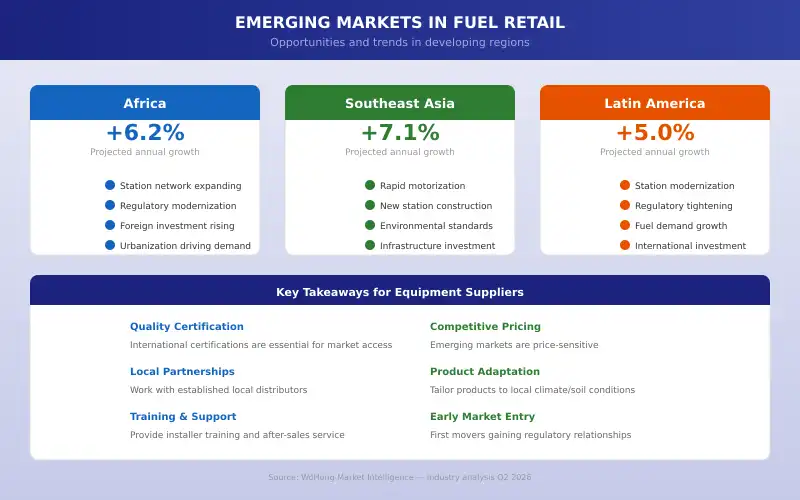
Emerging markets in Africa, Southeast Asia, and Latin America offer the strongest growth opportunities for fuel retail equipment suppliers in 2026.
Africa: The Next Frontier
Africa presents the most exciting long-term opportunity in the global fuel retail market. With projected annual growth of 6.2%, the continent is experiencing rapid urbanization and expanding vehicle ownership. Many African nations are building modern fuel retail networks from the ground up, creating demand for complete station equipment packages. International quality standards are becoming more important as regulatory frameworks mature. The key challenge is balancing quality requirements with price sensitivity in these developing markets.
Southeast Asia: Rapid Modernization
Southeast Asia offers the highest current growth rate at 7.1%, driven by economic development across Indonesia, Vietnam, Thailand, and the Philippines. Existing stations are being upgraded to meet international environmental standards, while new station construction is booming in rapidly urbanizing areas. Governments in the region are increasingly adopting Stage III vapor recovery requirements and secondary containment standards, creating strong demand for modern equipment. Local manufacturing is expanding but sophisticated imported equipment still commands a premium.
Latin America: Regulatory Transformation
Latin America is undergoing a significant regulatory transformation, with countries like Brazil, Mexico, and Chile tightening environmental requirements for gas stations. The market is growing at 5.0% annually, driven by station modernization programs and environmental compliance deadlines. Many older stations need complete equipment overhauls to meet new standards, creating substantial replacement demand. International suppliers with certified equipment and local support networks have a competitive advantage.
Market Entry Strategies
Successful entry into emerging markets requires a thoughtful approach. Obtain relevant international quality certifications that are recognized in target markets. Develop partnerships with established local distributors who understand regulatory environments and customer relationships. Provide comprehensive training programs for local installers and maintenance technicians. Offer competitive pricing while maintaining quality standards appropriate for each market segment. Invest in local service and support infrastructure to build long-term customer relationships.
Product Adaptation Considerations
Products sold in emerging markets may need adaptation to local conditions. Consider tropical climate requirements for equipment operating in high heat and humidity. Account for variable fuel quality and composition common in some developing markets. Adapt to local installation practices and available skill levels. Develop user interfaces and documentation in local languages. Ensure compliance with local electrical and safety standards.
Risk Management
Operating in emerging markets carries specific risks that need management. Currency fluctuations can affect pricing and profitability. Regulatory changes may create uncertainty in compliance requirements. Supply chain disruptions can impact project timelines. Political and economic instability in some markets requires contingency planning. Building strong local partnerships helps mitigate many of these risks.
Outlook
The long-term outlook for emerging market fuel retail is strongly positive. Urbanization, economic growth, and regulatory modernization will continue to drive demand for quality station equipment. Suppliers who establish early market presence and build lasting local relationships will reap the benefits of these growing markets for years to come.
WoHong Petrochemical International Department monitors global market developments to serve customers across six continents. Contact us for market intelligence and competitive equipment solutions.