
When designing underground fuel storage and dispensing systems, choosing between composite pipes and traditional steel piping is one of the most consequential engineering decisions for gas station owners, contractors, and petroleum equipment distributors. This comparison examines five critical performance dimensions to help procurement professionals make informed decisions.
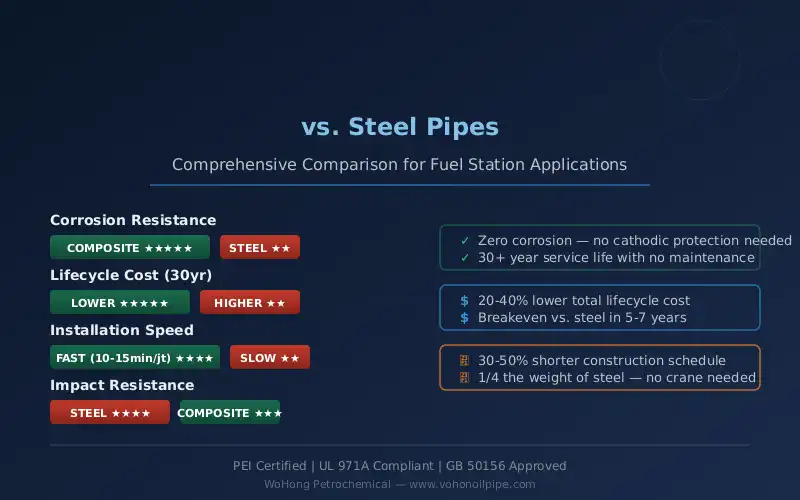
Corrosion Resistance: The Decisive Advantage of Composite Materials
Steel underground pipes, even with cathodic protection and three-layer PE coating, remain vulnerable to corrosion over a 20-30 year service life. Soil pH, moisture content, stray electrical currents, and microbial activity all contribute to gradual metal deterioration. Once corrosion pitting penetrates the pipe wall, fuel leaks contaminate groundwater and trigger expensive remediation liabilities.
Underground composite pipes — typically constructed from fiberglass-reinforced epoxy or polyester resins — are inherently immune to galvanic and electrochemical corrosion. The inert polymer matrix does not react with acidic soils, chlorides, or sulfates commonly found in gas station excavations. This eliminates the need for cathodic protection monitoring, coating inspections, and anode bed replacements over the pipe’s service life. For gas station owners planning 30-year site operations, composite pipes offer a corrosion solution that requires no ongoing maintenance.
Lifecycle Cost Analysis: Beyond Upfront Pricing
The initial material cost of underground composite pipes is typically 15-30% higher than equivalent steel pipe. However, a comprehensive lifecycle cost assessment tells a different story. The following factors contribute to composite pipes achieving lower total cost of ownership:
- Zero cathodic protection system installation and monitoring costs
- No periodic coating repairs or joint wrap maintenance
- Lighter weight reduces transportation and handling expenses
- Faster installation with fewer heavy-lifting requirements
- Extended replacement cycles — composite pipe service life routinely exceeds 30 years vs. 20-25 years for well-maintained steel
- Significantly lower environmental liability insurance premiums in regions where composite pipe use reduces leak risk ratings
Third-party lifecycle studies published by the Petroleum Equipment Institute (PEI) indicate that composite underground piping systems achieve 20-40% lower total lifecycle costs compared to steel in typical retail fuel station installations over 30-year evaluation horizons. The breakeven point is typically reached within 5-7 years of installation.
Installation Efficiency and Labor Requirements
Steel underground pipe installation requires specialized welding or threading equipment, certified welders, lifting machinery for heavy pipe sections, and extensive coating inspection protocols. A typical steel pipe joint installation takes 45-60 minutes plus coating curing time. Welding also introduces fire safety concerns in fuel station environments.
Composite underground pipes use adhesive-bonded or threaded mechanical joints that can be assembled in 10-15 minutes per joint with minimal training. The lightweight construction (one-quarter the weight of equivalent steel pipe) means two workers can handle installation without forklifts or cranes. Adhesive systems cure within 30 minutes to handling strength, allowing backfill to proceed on the same day. This translates to 30-50% shorter construction schedules for fuel station piping networks.
Mechanical Integrity and Impact Resistance
While steel excels at point-load resistance and impact durability during backfill, modern composite pipe designs have closed this gap substantially. High-performance fiberglass-reinforced underground composite pipes achieve hoop tensile strengths exceeding 200 MPa and axial tensile strengths above 100 MPa. Key mechanical considerations include:
- Composite pipes handle vehicular traffic loads when installed at minimum 0.9m cover depth per PEI/RP100
- Flexural modulus of 10-15 GPa provides adequate stiffness for trench installations
- Compressive strength exceeds 250 MPa — sufficient for most fuel station loading conditions
- Impact resistance has improved significantly with advanced resin formulations incorporating impact modifiers
For installations requiring exceptional impact resistance — such as high-traffic truck stops with shallow cover depths — steel remains the preferred choice. However, for the vast majority of retail fuel station applications, properly selected and installed composite pipes deliver fully adequate mechanical performance.
Fluid Compatibility and Permeation Characteristics
Steel pipes provide an impermeable barrier to all liquid petroleum products and alcohol-blended fuels. Composite pipes, while highly resistant, require resin selection matched to the specific fuel blends being dispensed. Modern epoxy vinyl ester resins demonstrate excellent compatibility with:
- All gasoline grades including up to E85 ethanol blends
- Biodiesel blends up to B20
- Conventional diesel and ultra-low sulfur diesel (ULSD)
- Kerosene and jet fuel grades
- Defense logistics fuel products (JP-5, JP-8)
Permeation rates for hydrocarbon molecules through composite pipe walls are well below EPA and international regulatory thresholds. Third-party testing confirms that permeation losses from composite underground pipes are negligible over 30-year service periods, with methanol/gasoline blend permeation rates typically below 0.5 g/m²/day.
Regulatory Compliance and Environmental Considerations
Both steel and underground composite piping systems must comply with applicable environmental protection regulations. US EPA 40 CFR Part 280, European EN 13160, and Chinese GB 50156 standards provide specific requirements for underground piping systems at fuel facilities. Composite pipes offer several regulatory advantages:
- No cathodic protection testing records to maintain for regulatory inspection
- Third-party certification per UL 971, UL 971A, or EN 14125 for composite fuel piping
- Interstitial monitoring compatibility for double-wall composite pipe systems
- Reduced environmental audit scope when corrosion-related failure mechanisms are eliminated
In China, GB 50156-2021 explicitly permits fiberglass-reinforced plastic (FRP) underground pipes for fuel stations, and many provincial environmental bureaus now prefer composite solutions for new greenfield station projects due to their superior long-term environmental performance.
Selecting the Right Pipe Material for Your Project
The decision between underground composite pipes and steel pipes ultimately depends on site-specific conditions, budget parameters, and regulatory requirements. Composite underground pipes represent the modern standard for retail fuel station piping, offering superior corrosion resistance, lower lifecycle costs, faster installation, and more predictable long-term performance. Steel piping remains viable for high-impact or shallow-cover applications where mechanical robustness is the primary concern.
For procurement managers and petroleum equipment distributors evaluating supply chain options, stocking both technologies allows responsive support for diverse installation requirements. However, the global trend is clear: underground composite pipe adoption continues to accelerate as environmental regulations tighten and total-cost-of-ownership calculations favor corrosion-proof solutions.
Contact WoHong Petrochemical International Department for technical specifications, pricing, and project consultation on underground composite pipe systems for fuel stations.