
Key Market Drivers Reshaping Global Fuel Station Infrastructure in 2026
The global fuel station equipment market is undergoing its most significant transformation in decades as environmental regulations tighten, emerging economies accelerate infrastructure development, and station operators prioritize lifecycle cost optimization over upfront pricing for underground piping and vapor recovery systems.
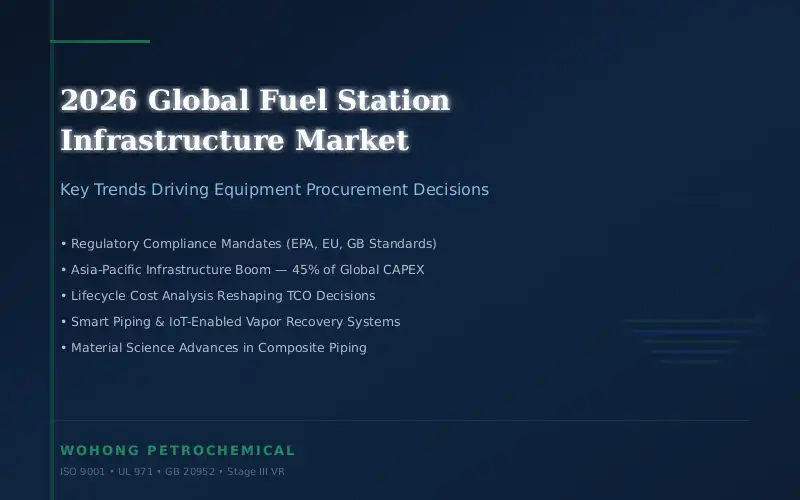
Regulatory Pressure Driving Compliance-Driven Procurement
Governments across North America, Europe, and Asia-Pacific are implementing stricter environmental standards for underground storage systems. The U.S. EPA’s updated underground storage tank (UST) regulations, now fully effective in 2026, mandate secondary containment and interstitial monitoring for all new and replaced piping systems. Similarly, the European Union’s revised Industrial Emissions Directive requires Stage III vapor recovery systems on all new fuel dispensing facilities with throughput exceeding 500 m³ per year.
For procurement managers and engineering consultants, this regulatory wave means that compliance specifications are no longer optional considerations but mandatory procurement criteria. Fuel station owners who invest in certified Stage III vapor recovery equipment and third-party-tested underground composite piping systems gain a dual advantage: regulatory compliance across multiple jurisdictions and documented due diligence protection during environmental audits.
Asia-Pacific Infrastructure Boom Creates Sustained Demand
The Asia-Pacific region accounts for over 45 percent of global fuel station infrastructure investment in 2026. China’s continued highway network expansion, India’s push to increase fuel station density from 1 station per 100 km of national highway to 1 per 60 km, and Southeast Asian nations modernizing their retail fuel networks are collectively driving unprecedented demand for underground fuel storage and dispensing equipment.
Chinese manufacturers like WoHong Petrochemical have positioned themselves as key suppliers for this build-out, offering Stage III vapor recovery systems and underground composite pipe solutions that meet both domestic Chinese standards (GB 20952, GB 50156) and international benchmarks such as UL 971 and EN 13160. This dual-certification capability reduces qualification cycles for international buyers by 40 to 60 percent compared to sourcing from vendors who only hold single-market certifications.
Lifecycle Cost Analysis Shifts Procurement Decisions Away from Lowest-Bidder Mentality
A growing body of total cost of ownership (TCO) data is changing how fuel station operators evaluate piping and vapor recovery equipment. A 2025 study published by the Petroleum Equipment Institute found that underground composite piping systems with proper cathodic protection and factory-fabricated fittings deliver 30-year service lives with maintenance intervals of 8 to 12 years, compared to steel piping systems that require major repairs or replacement at 15 to 20 years.
The TCO calculation is equally compelling for vapor recovery systems. Stage III vapor recovery units with corrosion-resistant aluminum housings, self-diagnostic control modules, and modular cartridge-style valve assemblies reduce unplanned downtime by approximately 60 percent compared to first-generation units, translating to fuel dispensing revenue protection of $12,000 to $18,000 per dispenser annually.
Supply Chain Regionalization and Inventory Strategy
Post-pandemic supply chain lessons have prompted fuel station developers to reconsider single-source procurement strategies. Regionalization of manufacturing is accelerating, with companies establishing production footprints in Southeast Asia, the Middle East, and Eastern Europe to serve nearby markets while reducing lead times and freight costs.
For buyers evaluating suppliers, key supply chain due diligence factors now include: raw material sourcing transparency, buffer stock policies for critical components (control modules, vapor valves, pipe fittings), and documented lead times for 50-unit, 200-unit, and 1,000-unit order quantities. Suppliers who maintain regional warehouses stocked with the top 30 stock-keeping units for vapor recovery and underground piping systems can reduce procurement lead times from 12 to 16 weeks to 3 to 5 weeks.
Digitalization and Remote Monitoring Capabilities
The integration of Internet of Things (IoT) sensors into fuel station infrastructure has moved from pilot projects to standard procurement specifications. Modern Stage III vapor recovery systems now come equipped with real-time pressure monitoring, automated leak detection logging, and cloud-based compliance reporting that integrates with environmental management systems.
Underground composite piping systems are also benefiting from digitalization. Smart pipe systems incorporating distributed fiber-optic sensing technology can detect hydrocarbon micro-leaks, temperature anomalies, and ground movement along the entire pipe run, not just at discrete monitoring points. While these systems carry a 15 to 25 percent premium over conventional piping, insurance and liability cost savings typically offset the premium within three to five years of operation.
Material Science Advances in Composite Piping
The chemical resistance and mechanical properties of underground composite pipes have improved substantially over the past five years. New resin formulations offer enhanced resistance to ethanol-blended fuels up to E85, biodiesel blends including B100, and the aggressive aromatic hydrocarbons found in high-octane racing fuels. These material advances enable station operators to future-proof their underground infrastructure against evolving fuel formulations without costly pipe replacement.
Fiber-reinforced thermosetting resin pipes with corrosion-resistant inner liners now achieve flexural strengths exceeding 350 megapascals per ASTM D790, with hydrostatic design bases of 1,500 psi or greater per ASTM D2992. These specifications make modern composite pipes suitable for both retail filling stations and commercial fleet fueling facilities operating under higher pressure and flow rate conditions.
Recommendations for Procurement Professionals in 2026
For engineering procurement teams and fuel station developers evaluating equipment suppliers, the following checklist provides a structured approach to vendor qualification. First, verify that the supplier’s Stage III vapor recovery systems hold current UL, CE, or equivalent certification with documented third-party test results for detection accuracy and vapor recovery efficiency at 3,000 to 10,000 hours of simulated operation. Second, request detailed material data sheets for underground composite pipe systems, including long-term hydrostatic strength regression curves and chemical compatibility matrices for the specific fuel formulations used in your market. Third, audit the supplier’s quality management system, including ISO 9001 certification scope, in-process inspection records, and factory acceptance test procedures for critical subassemblies such as vapor control modules and pipe coupling joints. Fourth, evaluate documented lead times, regional warehouse locations, and emergency replacement part availability for at least 90 percent of the components in a typical fuel station configuration. Fifth, request case studies and reference installations from the supplier’s existing customers, focusing on projects with comparable scale, climate conditions, and regulatory requirements to your own.
Outlook: Market Opportunities and Strategic Timing
The global fuel station equipment market is projected to grow at a compound annual growth rate of 5.8 percent between 2026 and 2031, reaching an estimated value of $18.7 billion. The most significant growth segments are underground storage and piping systems, accounting for roughly 38 percent of total market value, followed by vapor recovery and environmental compliance equipment at 27 percent. Station developers and procurement managers who establish relationships with qualified multi-product suppliers during this growth window will benefit from better pricing stability, priority allocation during supply-constrained periods, and reduced qualification cycles for future projects. As the regulatory environment continues to tighten and infrastructure investment accelerates across Asia-Pacific and the Middle East, strategic procurement planning for underground piping and vapor recovery equipment is not merely an operational decision but a competitive advantage.