
Installing underground composite fuel piping is mostly a sequence problem: each step depends on the one before it, and once the trench is backfilled, correcting a mistake becomes expensive. The checklist below covers the twelve items that field crews should confirm before closing a trench on a gasoline station or fuel depot project. Work through them in order, record the results, and keep the records with the as-built drawings.
1. Trench preparation and bedding
Confirm the trench depth, width and bottom elevation against the drawings before any pipe arrives on site. The trench bottom should be free of sharp rocks, construction debris and standing water. A sand or fine-soil bedding layer is normally placed and compacted to a uniform thickness so the pipe rests on a continuous, smooth surface rather than on isolated high points.
- Verify trench bottom elevation and slope against the design profile;
- Remove rocks, roots and hardened debris that could point-load the pipe;
- Place and compact the bedding layer to consistent thickness;
- Keep the trench dry during pipe laying.
2. Pipe handling and inspection on delivery
Composite pipe is lighter than steel, which makes handling easier, but the outer jacket and the end faces still deserve a look before each length goes in. Inspect for cuts, deep abrasions, ovality at the ends and contamination inside the bore. Coil or straight lengths should be stored on supports, not dragged across the ground.
3. Laying sequence and alignment
Lower the pipe into the trench without dragging it along the trench bottom. Maintain the designed alignment and any required slope toward the low point or collection sump. Where the line changes direction, respect the manufacturer’s minimum bend radius rather than forcing a kink.
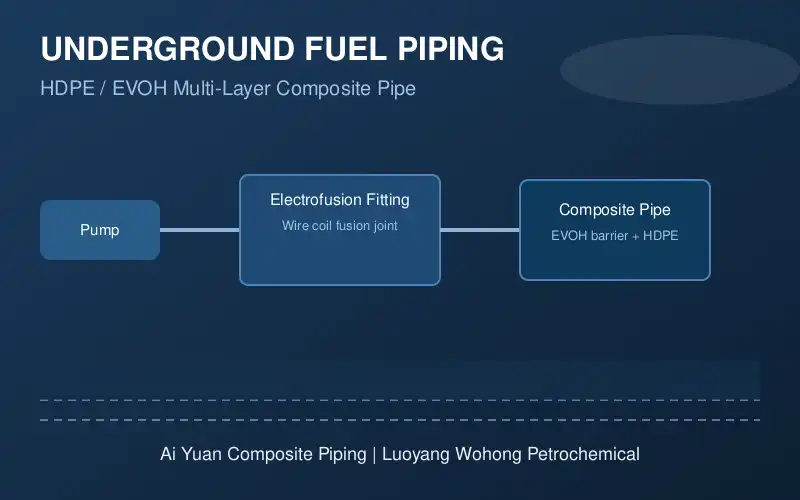
Once the pipe is in position, check that it sits evenly along its length and that no section is left bridging across a void in the bedding.
4. Electrofusion joint preparation
Joint quality decides whether the line stays tight for its service life. Scrape the pipe surface to remove the oxide layer over the full insertion depth, mark the insertion depth, clean the surface with the specified agent, and clamp the assembly so it cannot move during the fusion cycle. Follow the fitting supplier’s fusion parameters exactly and log the cycle for every joint.
- Cut the pipe square and deburr the end;
- Mark the insertion depth on the pipe surface;
- Scrape the full insertion area evenly, then clean it;
- Insert into the fitting without rotating, and clamp both sides;
- Run the fusion cycle and record the parameters;
- Let the joint cool undisturbed before removing the clamp.
5. Pressure testing
Pressure testing is normally performed on the completed line before backfill. The test medium, pressure, hold time and acceptance criteria come from the project specification. Record the pressure trace, ambient temperature and any observed drop. Joints should be exposed and accessible during the test so that a leak can be located without excavating.
6. Documentation before backfill
Before the trench is closed, collect the records: joint logs with fusion parameters, test records, alignment and depth measurements, and photographs of the line in the trench. These records support future maintenance and any third-party inspection of the installation.
| Checklist stage | What to confirm | Record kept |
|---|---|---|
| Trench and bedding | Depth, width, slope, bedding thickness | Inspection sheet |
| Pipe condition | Jacket integrity, end faces, cleanliness | Delivery note and photos |
| Fusion joints | Scrape, alignment, fusion parameters | Joint log per fitting |
| Pressure test | Test pressure, hold time, result | Test chart |
| Backfill | Backfill material, compaction, marker tape | As-built mark-up |
Common questions
Does composite fuel piping need a different bedding than steel?
The bedding principle is the same: a continuous, smooth support with no hard points. Composite pipe is more tolerant of light handling, but point loads from rocks and debris still reduce service life, so bedding quality should be controlled to the project specification.
Can joints be backfilled immediately after fusion?
Joints should be allowed to cool fully and should pass any required visual check before backfill. Backfilling while a joint is still hot can move the assembly and compromise the joint.
What should be photographed before backfilling?
Photograph the full route with depth references, every fusion joint with its identification number, the test setup and gauge readings, and any crossing with existing utilities. These photographs are the most practical record if the line is ever excavated later.
Luoyang Wohong Petrochemical Equipment Co., Ltd. supplies double-wall composite fuel piping, fittings and electrofusion accessories for gas station and fuel depot projects. Contact us for pipeline layout review and product selection support.