
Routing and burial depth are the two decisions that lock in almost everything else on an underground composite fuel piping job. Set them out properly and the trench, the fitting positions, the slope to the tank and the later inspection all follow naturally. Get them wrong and the pipe may be perfectly manufactured while the installation still fails review. The practical sequence is to fix the route on a marked drawing, confirm the minimum cover depth for each crossing and traffic condition, then walk the route on site and adjust before a machine touches the ground.
What has to be settled before trenching starts
Four things should be agreed and signed off: the horizontal route with offsets from fixed site features, the burial depth for each segment including crossings, the positions of fittings and any transition to a different pipe type, and the location of the test and inspection points. If any of these is still open when excavation begins, the crew will make the decision in the field, and field decisions are hard to document later.
How burial depth is decided
The governing factor is the load above the pipe, not a single number copied from a previous job. Cover depth has to satisfy three things at once: protection from traffic loading, protection from frost or root action where relevant, and the slope required for the pipe to drain or to carry liquid where the design calls for it.
- Identify every traffic category along the route, from light vehicle areas to heavy axle loads at the forecourt edge;
- Set a minimum cover for each category and mark the controlling section on the drawing;
- Check crossings, where the depth usually has to increase to pass under a service or a slab;
- Confirm the finished level, not just the excavated level, since paving and sub-base add thickness above the pipe;
- Record the agreed depth per chainage so the as-built drawing can be produced from measured values rather than from memory.
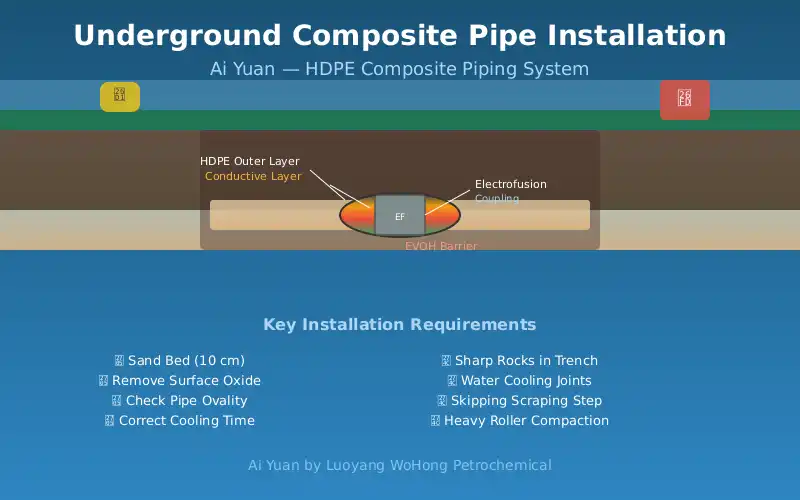
Setting out on site
Mark the centre line, then walk it. The purpose of the walk is to find the things a drawing does not show: existing services that were never surveyed, drains, kerb lines that have been rebuilt, and access that a machine cannot realistically use. Any deviation agreed on site should go back onto the drawing the same day and be countersigned, otherwise the as-built record will not match the installation.
Points that decide whether the installation passes review
| Item | What to confirm | Why it is checked |
|---|---|---|
| Cover depth | Measured per chainage against the drawing | The most common point raised at inspection |
| Bedding and surround | Material and thickness as specified | Affects long term support and any future settlement |
| Route deviations | Signed off on site and reflected in the drawing | Keeps the as-built record usable |
| Fitting positions | Away from slab edges and heavy load points where possible | Simplifies access for later joint inspection |
| Test points | Accessible after backfill and paving | Needed for the acceptance test and for future checks |
Documentation worth producing during the works
Depth measurements taken section by section, photographs of the bedding and of each joint before backfill, and a marked-up drawing showing the final route are the three records that carry the most weight at handover. Producing them as the work proceeds costs very little; reconstructing them afterwards is slow and never quite accurate.
Frequently asked questions
Can the burial depth be reduced under a light traffic area?
It depends on the loading the designer has assumed and on the bedding and protection provided. The reduction should come from a design decision recorded on the drawing, not from what the excavator happened to dig, and the protection measures that accompany a reduced cover should be stated explicitly.
What if an existing service is found on the marked route?
Stop and re-route or provide the crossing detail the designer specifies. Adjusting the route locally is usually cheaper than trying to work around a service with insufficient clearance, and the change must be reflected in the drawing the same day.
How should depth be measured for the record?
Measure from the top of the pipe to the finished surface level at the same chainage, and record both the reading and the chainage. Measuring from the excavated trench bottom instead of the finished level is a common source of confusion at handover.
Luoyang Wohong Petrochemical Equipment Co., Ltd. supplies double-wall composite fuel piping, fittings and electrofusion accessories for gas station and fuel depot projects. Contact us for pipeline layout review and product selection support.