
When a gas station replaces its underground fuel piping, the choice usually comes down to composite piping or steel piping. Composite piping — typically HDPE with an EVOH barrier layer — has become the common choice for new builds and retrofits, while steel pipe is still used where site conditions, existing specifications or local practice call for it. This guide compares the two across weight, corrosion behaviour, jointing, installation, leak detection and the factors that drive cost, so you can judge which one fits your project.
What Each Material Actually Is
- Composite piping: a multi-layer pipe built around an HDPE structure with an EVOH barrier layer. The barrier limits permeation of fuel vapour and oxygen, and the HDPE layers provide flexibility and chemical resistance.
- Steel piping: carbon steel pipe, usually with a protective coating or wrapping, joined by welding or threaded fittings depending on the specification.
Head-to-Head Comparison
| Criteria | Composite piping | Steel piping |
|---|---|---|
| Weight and handling | Light, supplied in coils or long lengths; less heavy lifting on site | Heavy; needs more plant and more joints per run |
| Corrosion behaviour | Non-metallic, not subject to galvanic or rust-through corrosion | Requires coating, wrapping and often cathodic protection |
| Jointing | Mechanical or electrofusion fittings; fewer field welds | Welding in the trench or at grade; weld quality is a key control point |
| Flexibility and routing | Can follow curved trenches and accommodate minor ground movement | Rigid; requires fittings for every change of direction |
| Leak detection compatibility | Suits interstitial monitoring and sump-based detection layouts | Compatible, but coated sections can complicate detection access |
| Installation approach | Lighter excavation, faster trench work, smaller crew | Heavier excavation, more equipment, longer programme |
| Service life considerations | Durability driven by permeation barrier and fitting integrity | Durability driven by coating condition and corrosion control |
| Cost drivers | Material price, fitting count, trench length, site access | Material price, welding labour, coating, cathodic protection |
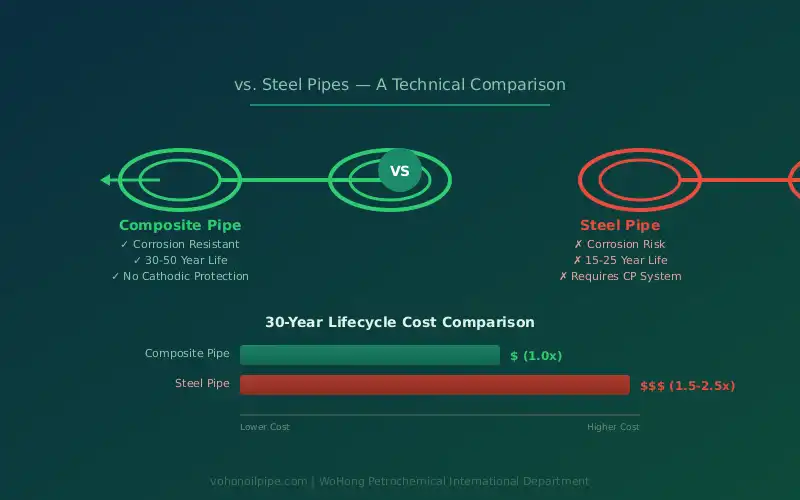
Where Composite Piping Wins
- Retrofit projects with limited access: coiled pipe can be pulled through shorter trenches and around existing structures with fewer joints.
- Corrosive soil or high water table: removing the steel corrosion question removes a long-term maintenance item.
- Tight programmes: fewer welds and lighter handling usually shorten the on-site phase.
- Sumps and interstitial monitoring: composite layouts adapt well to modern leak detection arrangements.
Where Steel Still Makes Sense
- Specifications or local practice that explicitly call for steel on a given line.
- Runs where high mechanical loads or above-ground sections require rigid support.
- Sites where an existing steel network is being extended in a matching material.
- Availability constraints, where the local supply chain for steel is stronger.
How to Decide for Your Station
- Confirm the diameter, flow requirement and number of dispensers the line must serve.
- Review the trench route: length, bends, crossings and available working space.
- Check ground conditions and groundwater level, since these drive the corrosion case for steel.
- Agree the leak detection arrangement, because it affects sump and fitting selection.
- Compare total installed cost, not just pipe price per metre — jointing, plant and programme all count.
Frequently Asked Questions
Q: Can composite piping be used for both suction and pressure lines?
A: Yes. Composite pipe is used for suction, vent, fill and pressure lines; the wall construction and fittings are selected according to the service.
Q: Is composite piping suitable for alcohol-blended fuels?
A: The EVOH barrier and HDPE structure are chosen for fuel service; confirm the fuel type with the supplier so the correct grade is specified.
Q: Do composite systems still need leak detection?
A: Yes. Leak detection is a regulatory and operational requirement regardless of pipe material; composite layouts are simply easier to arrange for interstitial monitoring.
Q: Which option is cheaper?
A: It depends on the site. Composite pipe often reduces installation cost while steel can be cheaper on material alone in some markets; compare total installed cost for your specific route.
Luoyang Wohong Petrochemical Equipment Co., Ltd. manufactures HDPE–EVOH composite piping and related components for gas stations and fuel transfer systems. Contact us with your line list and site conditions for a specification discussion.