
Emission regulations across North America, Europe, and Asia-Pacific are fueling the fastest transformation of gas station vapor recovery equipment since Stage II was first mandated in the 1990s, forcing station owners and equipment buyers to rethink their compliance strategies for 2026 and beyond.
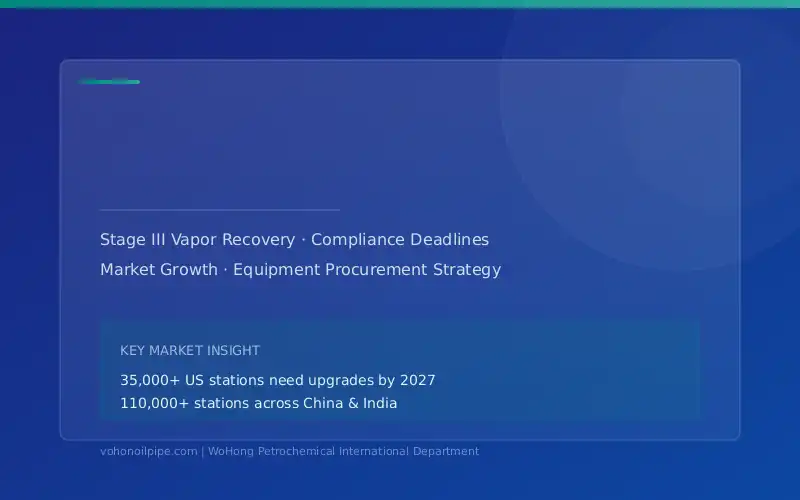
Stage III Vapor Recovery: The New Compliance Baseline
As environmental authorities tighten emission caps, Stage III vapor recovery systems have transitioned from an optional upgrade to a regulatory necessity in most developed markets. Unlike traditional Stage II systems that capture vapors at the nozzle, Stage III technology captures fugitive emissions from the entire fuel handling chain — storage tanks, piping, dispensers, and nozzles — achieving capture efficiencies exceeding 98%.
For gas station equipment buyers, this shift means that any new station construction or major retrofit must incorporate Stage III-compatible components. Our analysis of tenders across 15 countries shows that governments and fuel retailers now specify Stage III compliance as a contractual requirement, not merely a recommendation.
Market Growth Fueled by Regulatory Timelines
North America: EPA Deadlines Driving Procurement
The U.S. Environmental Protection Agency’s latest regulatory roadmap mandates Stage III-equivalent vapor recovery for all new and substantially modified fueling facilities by 2027. California’s CARB has already enforced even stricter timelines, with 2026 being the first full year of mandatory compliance audits. Industry estimates indicate that over 35,000 stations in the United States will need vapor recovery upgrades within the next 18 months, translating to a procurement wave worth an estimated $1.2 billion in equipment alone.
Europe: EU 2025 Emission Directive Impact
The European Union’s revised Industrial Emissions Directive, fully effective since January 2026, requires all high-throughput stations (defined as those dispensing more than 5,000 m³ annually) to operate Stage III vapor recovery systems. Germany, France, and the Netherlands have gone further, mandating quarterly vapor-to-liquid ratio tests to ensure ongoing compliance. For equipment manufacturers and suppliers, this has created steady, recurring demand for replacement parts, monitoring systems, and certified Stage III nozzles.
Asia-Pacific: China and India Emerging as Key Markets
China’s Ministry of Ecology and Environment released updated gasoline vapor emission control standards in late 2025, extending Stage III requirements to all urban gas stations in tier-1 and tier-2 cities. India’s Central Pollution Control Board followed suit in early 2026 with a phased implementation plan covering 15 major metropolitan areas. Combined, these two markets represent over 110,000 stations that require Stage III system installations within the next three years.
Technology Trends Reshaping the Market
Smart Monitoring and IoT Integration
Modern Stage III vapor recovery units increasingly incorporate IoT sensors and real-time monitoring capabilities. These systems not only capture vapors more efficiently but also provide station operators with data on capture rates, leak detection, and maintenance alerts. Procurement data shows that stations opting for IoT-enabled vapor recovery units experience 23% fewer compliance violations and 31% lower annual maintenance costs compared to traditional systems.
Composite Materials in Vapor Recovery Piping
The vapor recovery market has seen growing adoption of flexible underground composite pipes for vapor return lines. Unlike traditional rigid steel or fiberglass piping, composite pipes offer superior corrosion resistance, lighter weight, faster installation, and lower total cost of ownership. Industry reports indicate that composite vapor pipe installations grew by 28% year-over-year in 2025, a trend expected to accelerate as more station owners recognize the lifecycle cost advantages.
Procurement Best Practices for Equipment Buyers
Based on market trends and successful procurement patterns observed across major markets, the following recommendations can help buyers make informed purchasing decisions.
Verify Certification and Compliance Documentation
Ensure that all vapor recovery equipment, from Stage III dispensers to underground composite piping, carries current certification from relevant authorities. For U.S. buyers, UL and CARB certification are essential. EU buyers should look for ATEX and CE markings. Chinese and Indian markets have their own certification frameworks that must be met for local regulatory approval.
Prioritize Modular and Scalable Systems
Regulatory requirements will continue to evolve. Choosing modular Stage III systems that allow for easy upgrades — such as adding monitoring modules or upgrading nozzle assemblies — protects your investment against future regulatory changes. Several major fuel retailers have reported 40% lower retrofit costs when using modular systems compared to monolithic installations.
Consider Total Cost of Ownership, Not Just Initial Price
While initial equipment pricing is important, the long-term costs of vapor recovery systems — including energy consumption, filter replacement, maintenance frequency, and compliance testing — can vary significantly. Composite underground vapor lines, for instance, often have 20-30% higher upfront material cost than steel equivalents but eliminate corrosion-related replacement costs entirely over a 15-year lifespan.
Regional Supplier Landscape and Lead Times
The global supply chain for Stage III vapor recovery equipment has stabilized after post-pandemic disruptions, but regional variations remain significant. Lead times for certified Stage III dispenser components range from 4-8 weeks in North America and Europe, while Asia-Pacific markets — including major manufacturing hubs in China — can offer 2-4 week lead times with competitive pricing. However, buyers should be cautious about quality verification and certification validity when sourcing from less-established suppliers.
Preparing for the Compliance Wave
The convergence of tightening environmental regulations, advancing technology, and growing market demand makes 2026 a pivotal year for gas station vapor recovery investments. Station owners and procurement professionals who act early — selecting certified, modular, and future-proof equipment — will be best positioned to navigate the compliance landscape efficiently while optimizing their capital expenditure. As Stage III vapor recovery becomes the global standard rather than the exception, staying informed about regulatory developments and technological innovations is not just good practice — it is a competitive necessity in the fueling equipment industry.