
Fuel retail construction across Southeast Asia and the Middle East continues to support demand for buried piping and vapor recovery equipment, but the two regions are driven by different forces. In much of Southeast Asia the main driver is network growth, as operators add stations along expanding road and logistics corridors. In the Gulf, demand comes more from station upgrades, replacement of ageing forecourt equipment, and a steady tightening of expectations around vapor control.
Two different demand drivers
Where the driver is growth, the specification conversation tends to focus on speed of construction, standardised station layouts and equipment that can be replicated across many sites. Where the driver is upgrade work, the conversation starts with the constraints of an existing site: limited space, existing tank positions, and the need to keep the station trading during the work.
What buyers in these markets specify
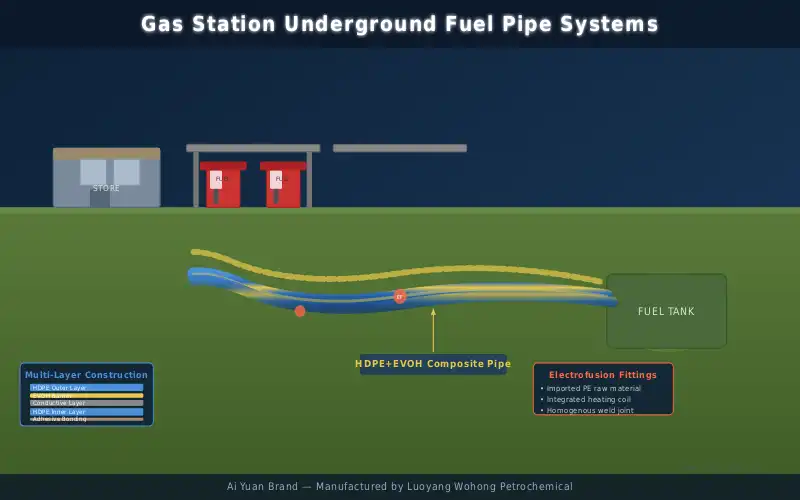
Across both regions, buried piping is increasingly specified as a double-wall composite system rather than steel. The reasons are consistent: resistance to corrosion in aggressive ground conditions, the availability of interstitial monitoring, and the reduction in joint count that comes from coiled pipe. Vapor recovery equipment follows the same path, moving from an optional extra on new builds toward a standard element of the station design.
Practical implications for procurement
- Confirm the vapor control expectation for the specific market before finalising the station design;
- Decide the piping system type and dimension early, because it drives trench dimensions and sump positions;
- Plan for equipment delivery in the sequence the site is actually built, not in the order the packages were purchased;
- Ask for installation support to be defined before, not after, the first joint is made;
- Keep a single point of responsibility for the buried system so transitions at tanks and dispensers are not split between suppliers.
Region by region
| Region | Main driver | What it means for equipment |
|---|---|---|
| Southeast Asia | Network growth along transport corridors | Standardised, repeatable station packages; fast installation |
| Gulf markets | Upgrades and tighter vapor control expectations | Retrofit-friendly equipment and phased installation |
| Island and coastal sites | Ground conditions and logistics | Corrosion-resistant pipe; shipment planning matters |
| High-volume urban sites | Throughput and space constraints | Compact equipment; careful vapor route design |
What to watch next
The direction of travel in both regions is toward systems that are easier to monitor rather than simply easier to install. That shifts value toward equipment with built-in sensing and toward suppliers who can support the site after handover, since a monitoring system that nobody can interpret adds little.
Common questions
Is steel still specified in these markets?
It is still used, particularly where local practice or existing infrastructure favours it. The shift is most visible on new builds and on full forecourt replacements, where the case for composite piping is strongest.
How early should the piping package be ordered?
Early enough that trench and sump dimensions can be fixed before groundworks start. Changing the piping system after the forecourt layout is set is one of the more expensive late changes on a station project.
Does the choice of vapor recovery equipment affect the piping design?
Yes. The vapor route, the return line and the location of the unit all interact, so the two packages are best designed together rather than bought separately and reconciled on site.
Luoyang Wohong Petrochemical Equipment Co., Ltd. supplies double-wall composite fuel piping, fittings and electrofusion accessories for gas station and fuel depot projects. Contact us for pipeline layout review and product selection support.