
Short answer: for buried gasoline service at a station you plan to operate for years, the premium for double-wall fuel pipe is almost always smaller than the cost of one corrective excavation, and the comparison becomes even clearer once monitoring, downtime and the resale or compliance story of the site are counted. Double wall is not a luxury product; it is a way of paying a modest amount on installation day to convert a hidden leak from an emergency into a maintenance event. There are also honest cases where single wall remains the sensible choice, and this article walks through both sides with numbers in the right units: not just the invoice, but the whole life of the line.
Why the price gap looks bigger on quote day
Quote day is the worst possible moment to judge this decision, because the invoice shows only one column of the ledger. A double wall line costs more per meter than its single wall cousin, and that difference multiplies visibly across a long run, so the first instinct is to trim it. What the quote does not show is the shape of the risk it absorbs. A buried fuel line carries product for decades under a forecourt where every later intervention costs an excavation, a closure of pumps, and a disruption of trading. When the comparison is framed as pipe price versus lifetime intervention cost, the premium starts to look like what it actually is: cheap insurance with a structural form. Buyers who jump straight from the quote to a yes or no tend to ask the wrong question; the useful question is what happens, in money, if the line ever needs attention.
What actually drives the premium
The extra cost of a double wall system is not mysterious, and breaking it down helps buyers see which parts they can influence:
| Cost component | Single wall | Double wall |
|---|---|---|
| Pipe itself | Lower price per meter | Higher price per meter, two walls and an annulus |
| Fittings and terminations | Standard range | System matched parts, slightly more per point |
| Leak detection | External methods only | Annulus monitoring, interstitial access at each end |
| Installation labor | Baseline | Close to baseline with modern electrofusion practice |
| Documentation value | Basic records | Stronger file for inspections and site transactions |
Two observations fall out of this table. First, most of the premium sits in the pipe and fittings, not in labor, because a trained crew joins a double wall line in nearly the same time as a single wall one. Second, the monitoring column is not an accessory; on a double wall system it is the mechanism that turns containment into early warning, and it is the reason the wall exists at all. The selection guide for single and double wall systems expands on how these components work together.
Where the extra money goes: the annulus and the monitoring loop
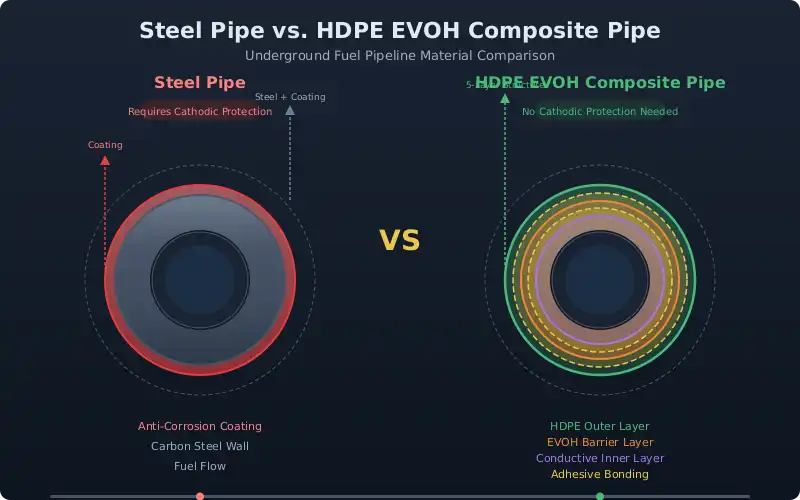
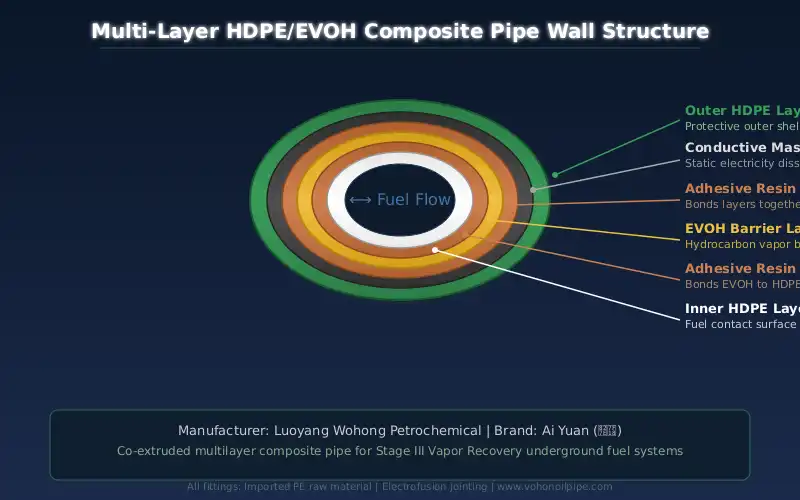
A double wall pipe is two walls with a monitored space between them, and that space is what the buyer is really purchasing. If the product wall ever weeps, the fluid collects in the annulus where the monitoring system can see it, long before it reaches the soil. The economics of that arrangement deserve attention. A leak found by groundwater sampling is found late, after environmental consultants, regulatory reporting and remediation have all entered the story. A leak found in an annulus is found early, while it is still a few liters inside a sealed channel, and the repair happens on a schedule the operator chooses. The difference between those two scenarios is routinely more money than the entire premium on the piping, and that is before counting the trading days lost to an unplanned excavation.
The lifecycle math that changes the answer
Buyers who want the decision to rest on numbers rather than instinct can run a simple lifecycle comparison in an afternoon, and the exercise itself usually settles the question:
- Price both systems for the actual site: pipe, fittings, sumps, monitoring points and the labor to install them, on the same drawing;
- Add the monitoring difference honestly, including any sensor wells or interstitial equipment, so nothing is hidden inside the comparison;
- Estimate the probability-weighted cost of one product release under each system, using the site own soil, water table and proximity to receptors rather than generic figures;
- Include downtime: the trading value of the forecourt for the days an unplanned excavation would take;
- Count the documentation effect on inspections, financing and any future sale of the site, where a monitored containment system reads as reduced liability;
- Compare the totals across the expected service life of the line, not across the first invoice.
Run this on real numbers and the premium rarely survives contact with the release scenario. The forecourt piping budget guide shows how these items map onto a real project budget.
When single wall remains the sensible choice
Integrity requires saying the other side. Single wall remains legitimate in settings where the risk profile is genuinely low: sites where local practice accepts it, vent or low-hazard lines, temporary installations, or budgets where containment is handled by other means and the owner consciously carries the residual risk. What matters is that the choice is made with open eyes. A single wall decision made because the premium was trimmed from a quote is a different thing from one made because the application does not justify the extra wall. Operators who choose single wall for honest reasons should still invest in the monitoring they can have, because early detection is valuable under any wall configuration.
Reading quotes without mixing categories
A final practical note, because most bad cost comparisons happen inside the quote review. When two suppliers price a double wall line differently, check that both quotes contain the same scope: the same monitoring provisions, the same termination hardware, the same documentation package. A cheaper quote that omits interstitial access fittings is not cheaper; it has moved the cost into a gap. The same discipline applies when comparing double wall against single wall: make sure each option carries its full monitoring story, and resist the temptation to compare a monitored system against an unmonitored one on pipe price alone. Quotes are only comparable when the scope lines up, and the lifecycle decision deserves a clean comparison, not a spreadsheet illusion.
Frequently asked questions
How large is the typical premium for double wall piping?
The gap varies with diameter, run length and the monitoring scope included, and it has narrowed as production of double wall systems scaled up. Rather than quoting a percentage that would not survive contact with a real project, the fair statement is that the premium concentrates in the pipe and fittings, while labor differences are small, and the monitoring equipment that gives the wall its value is a separate line worth pricing explicitly.
Does double wall pipe need special maintenance?
The maintenance load is different rather than heavier. Periodic checks of the monitoring system, including the interstitial access points and any sensor equipment, take the place of some of the vigilance a single wall site must apply through groundwater or vapor observation. Most stations find the double wall routine simpler, because the annulus tells them directly whether the line is tight instead of making them infer it from indirect signs.
Can an existing single wall line be upgraded later?
Retrofitting double wall onto an existing line is not practical, because the annulus and monitoring are structural features of the pipe itself. What stations can do later is add monitoring around an existing single wall line, or replace selected runs with double wall during planned works. This is one reason the decision matters most at new construction and full repiping moments, when the premium buys the complete containment system rather than a partial improvement.
Containment underground is one half of the emission story, and the vapor recovery unit cost factors from the sister line cover the other half, where captured vapors are processed above ground.
Luoyang Wohong Petrochemical Equipment Co., Ltd. supplies double-wall composite fuel piping, fittings and electrofusion accessories for gas station and fuel depot projects. Contact us for pipeline layout review and product selection support.