
Short answer: underground fuel piping falls into three families. Fiberglass systems carry the product inside a fiberglass wall with secondary containment built into the same structure. Flexible double-wall plastic piping — the composite family our own products belong to — pairs a polyethylene primary with an EVOH barrier and an outer jacket, with no rigid joints for long runs. Steel systems use welded steel pipe, sometimes inside a fiberglass or coated-steel containment, and rely on coatings and cathodic protection against corrosion. Each family has proven installations; they differ in joints, corrosion behavior, containment and how they are repaired.
Fiberglass piping
Fiberglass systems build primary and secondary containment into one wall. The product runs inside an inner fiberglass liner, and the annular space between walls doubles as the containment and the monitoring path — connect it to a leak detector at the control cabinet and any breach of either wall alarms before fuel reaches soil. The appeal is inherent corrosion protection and chemical resistance to fuel additives, which is why fiberglass has a long installation history at high-throughput sites. The trade-offs are real: joints are bonded by trained specialists, local parts and qualified installers are not available everywhere, and a damaged section is not a field-repair item. Sites choosing fiberglass are usually buying the containment record and the installer network as much as the pipe.
Flexible double-wall plastic piping
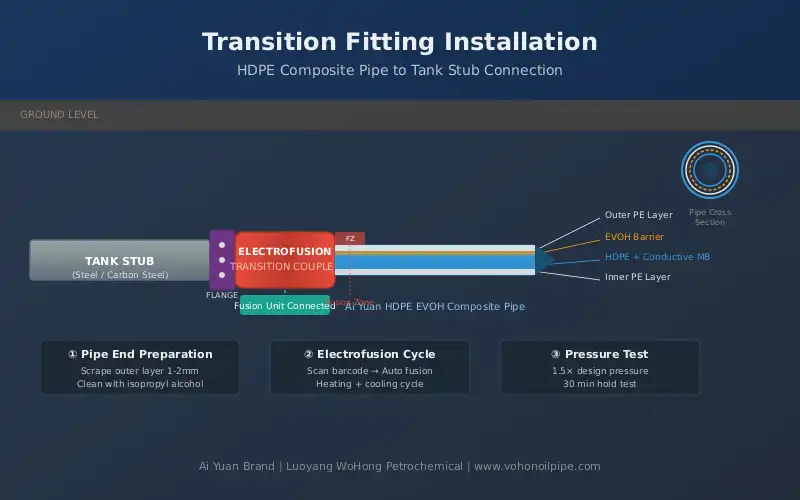
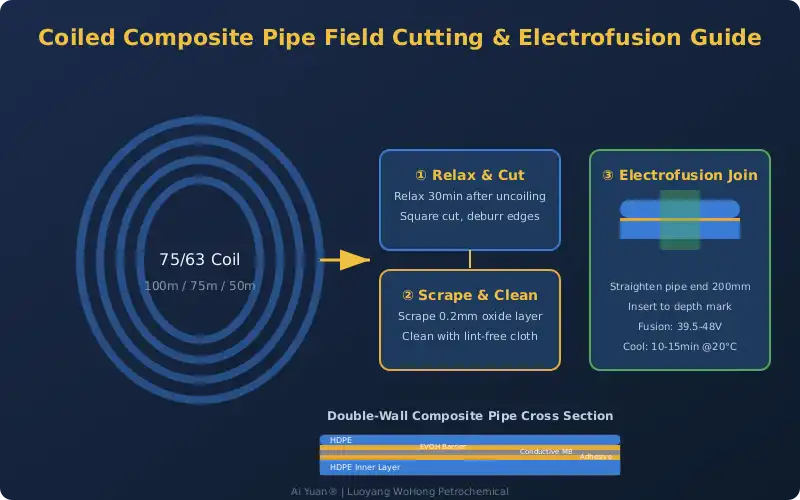
Flexible plastic piping arrives in coils, handles in long continuous runs, and — its signature advantage — can span up to a couple of hundred feet with no joints at all. Our double-wall composite family uses a polyethylene primary with an EVOH barrier and an outer jacket, with the interstitial space monitored the same way fiberglass annulus is. Early generations of flexible plastic piping had a mixed reputation from failures tied to material and installation practice; modern systems with defined installation procedures and electrofusion fittings have a very different record. Flexibility also means tolerance to ground movement that rigid systems answer with expansion loops. The comparison that matters to most buyers is covered in our composite versus steel procurement comparison.
Steel piping with containment
Steel primary piping — often jacketed in fiberglass or coated steel for containment — offers the highest structural strength against ground and surface loads and the deepest installer familiarity. It is also the only family whose failure mode is built in: steel corrodes, so the system depends on coatings staying intact and, where metallic components remain, cathodic protection staying active. That makes inspection a permanent obligation rather than a periodic one, and it is the reason many station owners convert away from steel during rebuilds. Welded joints are strong but slow, and every weld is a workmanship risk that testing has to catch later.
Repair and long-term obligations
The families separate most sharply after something goes wrong. A damaged section of flexible composite pipe is cut out and replaced with a new section joined by electrofusion fittings — a same-day job with common tooling. Steel repairs mean welding, recoating and re-testing, and the corrosion protection that was disturbed has to be restored to the same standard as the original. Fiberglass repairs are specialist work; the practical answer is usually section replacement by the installer who built the system. Ask any vendor what their system’s repair looks like in year eight, on a wet Wednesday, with the station trading — the honest answer tells you more than any spec sheet.
How the families compare
| Attribute | Fiberglass | Flexible double-wall plastic | Steel with containment |
|---|---|---|---|
| Corrosion behavior | Inherently corrosion resistant | Non-metallic, no corrosion path | Corrodes; needs coatings and protection |
| Joints | Bonded by specialists | Few or none in long runs | Welded, many joints |
| Secondary containment | Built into the wall | Built into the wall | Jacket or coated outer pipe |
| Installation speed | Specialist crews | Fast, coil-fed | Slow, weld-dependent |
| Ground movement | Rigid, movement answered by design | Flexible, tolerates settlement | Rigid, stress at joints |
| Repair after damage | Section replacement | Cut out and fuse a new section | Weld repair, recoat, re-test |
No column wins every row, which is why the decision is site-specific. The monitoring question — how a leak in either wall gets detected — is common to all double-wall options and is explained in our annulus monitoring guide.
Choosing between them
- Start with the containment requirement in your jurisdiction — single-wall options disappear from the list first;
- Check installer capability in your market; an exotic system installed by a crew learning it is worse than a conventional system installed well;
- Weigh soil and traffic loading: flexible systems absorb settlement, rigid systems need design attention;
- Price the full package — pipe, fittings, labor, testing and the monitoring tie-in — not the pipe alone;
- Ask what a damaged section costs to repair five years from now, because that answer differs sharply by family.
Most new station builds and rebuilds in our markets now land on double-wall composite, with fiberglass holding niches where its installer network is strong and steel surviving mostly in legacy systems being converted. The piping that serves the vapor side of a modern station follows the same logic, which our sister site covers in its terminal versus station vapor recovery comparison.
Frequently asked questions
Is flexible piping really joint-free?
Long runs can be installed with no joints when a single coil covers the distance; in practice most sites have a handful of electrofusion connections at transitions, tanks and dispensers.
Which family lasts longest?
All three can deliver decades when installed and tested correctly; the difference is what maintenance each demands to get there. Non-metallic systems largely remove corrosion as a failure mode.
Can a station mix piping families?
Yes, at transition fittings designed for the pair — composite to steel transitions are routine. The transition detail deserves the same installation care as the pipe itself.
Luoyang Wohong Petrochemical Equipment Co., Ltd. manufactures double-wall composite fuel piping, electrofusion fittings and Stage III vapor recovery piping for fuel stations, terminals and depots. Contact us for piping packages matched to your site layout.