
Short answer: fuel piping is tested more often than most owners expect — before backfill, again after backfill and before the system enters service, then on a repeating schedule that includes annual line leak detection, periodic tightness testing every few years, and visual checks of sumps and penetrations between formal tests. The intervals below reflect common practice across jurisdictions; your local rules set the binding version, and they are usually stricter, not looser.
Before backfill: the test that is hard to redo
The first test happens while the pipe is still visible. Isolate the section, pressurize it to the manufacturer’s recommended test pressure, and hold while watching for drop — our own systems are typically tested at one and a half times maximum operating pressure before the trench is closed. Local building or fire officials commonly witness this stage, and once the pipe is buried a failed joint becomes an excavation rather than a fitting swap. Testing before backfill is also your only chance to judge workmanship directly: every electrofusion joint, transition and penetration is still inspectable. The procedure is detailed in our pressure testing and leak verification guide.
After backfill, before service: the second test
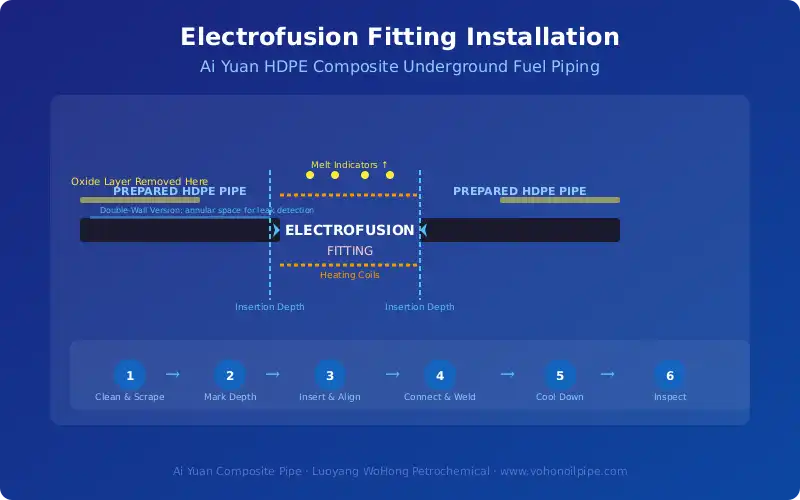
The second test protects against the damage window that backfill, compaction and paving create. Pipe that held pressure perfectly in the open trench can be nicked by a compactor or crushed by a surface load; testing again after backfill and before the system goes into service catches exactly that. Flushing and tightness verification at this stage also confirm the line is clean and ready for product — debris left from construction is a slow-burn failure that shows up as dispenser filter problems months later. Our flushing and tightness testing walkthrough covers the steps.
The repeating schedule once in service
| Interval | What happens | Why this interval |
|---|---|---|
| Monthly | Visual check of dispenser, tank and transition sumps and penetrations | Most failures announce themselves at accessible points first |
| Annually | Line leak detection test on pressurized piping; tank compliance testing | Required in most jurisdictions for pressurized lines |
| Every 2-3 years | Comprehensive tightness test of piping and containment | Catches slow leaks that annual screens can miss |
| After any modification | Re-test affected sections before returning to service | New work introduces new risk |
| After any repair | Verify the repair before product flows again | The repair itself must be proven |
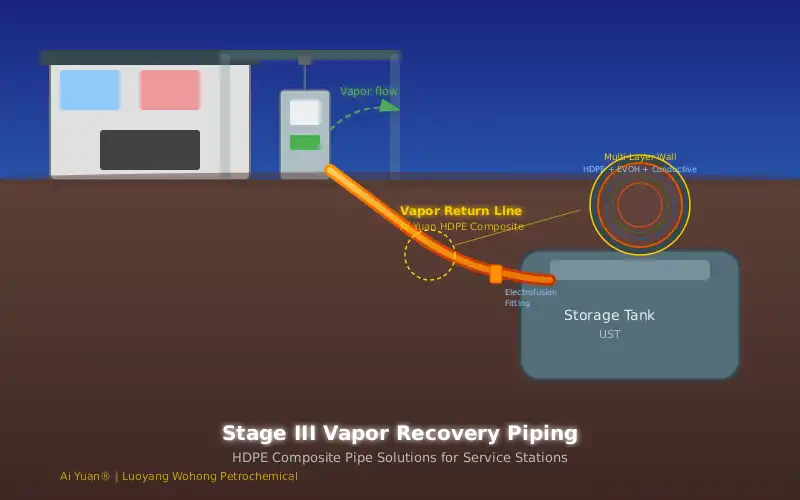
Two intervals earn their place by economics. The monthly visual check costs minutes and catches the majority of real-world problems — standing liquid in a sump, a weeping penetration, a stained fitting — long before they become reportable releases. The periodic tightness test catches the slow leaks that annual screening cannot, which matters because slow leaks are the ones that accumulate into remediation bills. The maintenance routine around these tests is laid out in our inspection and maintenance guide. The vapor side of the station runs on the same discipline, and our sister site’s vapor tightness troubleshooting guide covers what to do when the vapor path fails its own test.
Reading the hold: temperature and trend
A pressure test is a race between a real leak and the weather. Air expands and contracts with temperature, so a hold period that spans a warm afternoon will show pressure movement with no leak at all — which is why stabilized, temperature-compensated readings beat raw start-and-finish numbers every time. Record the initial pressure after stabilization, the final pressure, the elapsed time and the temperature at both ends. The trend across years is the real diagnostic: a system whose allowable drop creeps up test over test is telling you something a single pass cannot. Comparing this year’s hold against last year’s is the cheapest integrity monitoring a station owns.
When a test fails: isolating before digging
A failed test is a localization problem before it is a repair problem. Start by confirming the test itself — gauge calibration, isolation valves actually shut, temperature compensation applied — because a meaningful share of first failures are test artifacts. Then isolate section by section: close and blank at accessible points, test each segment, and let the pressure profile point at the failing joint or fitting rather than excavating on suspicion. With double-wall systems, check the interstitial monitoring reading at the same time; a pressure failure in the primary with a clean annulus reading narrows the search dramatically. Keep the failed-test record with the repair documentation — the pair of documents is what an inspector asks for, and what your own trend file needs.
What to have ready on test day
- A written test plan naming the sections, test medium, pressure and hold time;
- Calibrated gauges and a way to compensate for temperature during the hold;
- The as-built drawing, so a failure can be isolated to a section instead of a guess;
- Previous test records for comparison — trend beats single readings;
- Time scheduled in the station’s calendar, because tests skipped for traffic are the ones that matter.
One practical note on composite systems: because the pipe body does not corrode, the test is really about joints, fittings and penetrations. That is good news — it means the failure population is small and inspectable — but it also means a passing test never substitutes for looking at the sumps between tests.
Frequently asked questions
Does the piping really need two tests before service?
Yes, and they test different risks: the pre-backfill test proves the installation, the post-backfill test proves the burial process did not damage it. Skipping the second is a false economy.
Who can perform the tests?
Jurisdictions differ; many require a qualified testing service for the formal tests, while the monthly visual checks belong to station staff with a checklist.
How long do test records need to be kept?
Keep them for the life of the system. Trend data across years is the most valuable diagnostic tool a station owns, and inspectors increasingly ask for history rather than a single certificate.
Luoyang Wohong Petrochemical Equipment Co., Ltd. manufactures double-wall composite fuel piping, electrofusion fittings and Stage III vapor recovery piping for fuel stations, terminals and depots. Contact us for piping packages matched to your site layout.