
Backfill looks like the least technical part of a station piping job, and that is exactly why it causes problems. A composite line that was laid correctly can still end up with uneven support, point loads or deformation damage if the trench is closed carelessly. The goal of backfill is simple to state and easy to get wrong: give the pipe firm, even support along its whole length, with no stones, no voids and no aggressive compaction directly against the pipe wall.
What good support actually means
A buried pipe carries the loads around it by being evenly surrounded. Firm, continuous bedding under the pipe spreads the weight of traffic above onto the ground instead of letting the pipe act as a beam. Voids under the pipe do the opposite: they let the pipe span an empty space, and every passing vehicle then flexes the line slightly. Repeated flexing at the same spots is how joints and fittings find trouble years later.
That is why bedding material is placed and shaped before the pipe is laid, and why the first layers above the pipe matter more than everything after them.
The first lift does most of the work
Material placed directly around the pipe should be fine, free-flowing and free of sharp stones, spread in loose layers and compacted lightly on both sides of the pipe so the line does not shift. Compaction directly on top of the pipe in this first lift is avoided; the pipe wall should never take a compaction plate blow. The lift above the pipe, once there is enough cover, can be compacted normally.
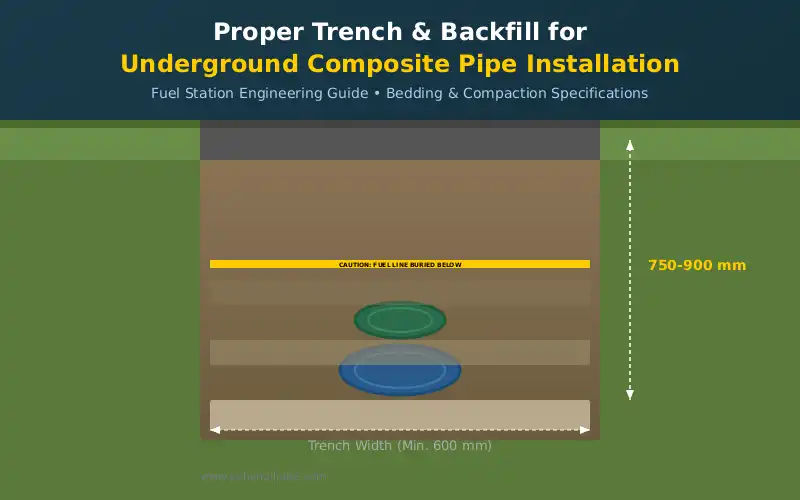
Warning tape and detection markers belong at the agreed depths in this zone, because this is the last chance to place them while everything above is still open trench.
Compaction: firm, not brutal
Each lift should be compacted enough to remove voids and prevent later settlement, but the energy delivered near the pipe stays modest. Heavy plate compactors dropped straight onto thin lifts above the pipe transmit sharp impacts into the wall. More lifts with lighter passes give the same reinstatement quality with none of that risk.
Dry, angular material compacts predictably. Mud and frozen lumps do not, and both should stay out of the trench even if the schedule is pressing.
Common backfill mistakes at stations
| Mistake | Consequence | Prevention |
|---|---|---|
| Rocks or debris in first lift | Point loads and wall damage | Specified clean fine material around the pipe |
| Voids under the pipe | Pipe flexing under traffic | Shaped, compacted bedding before laying |
| Plate on thin cover | Impact damage to the wall | More lifts, lighter passes near the pipe |
| Pipe shifted while filling | Stress carried into joints | Fill and lightly compact both sides in turn |
| Markers omitted or wrong depth | Damage during future excavation | Place tape and markers in the open trench |
| Uncontrolled settlement later | Surface problems and exposed stress | Compact each lift, do not bulk-dump |
Closing the trench in order
- Confirm bedding is shaped and the line is at the specified depth and slope;
- Place fine material around the pipe and compact the sides alternately;
- Install warning tape and detection markers at the agreed depths;
- Build the remaining lifts in compacted layers to subgrade level;
- Record lifts, materials and any deviations in the site documentation.
Frequently asked questions
Can the excavated soil be reused?
Yes, if it is clean, stone-free enough for the zone around the pipe and compactable in the site’s conditions. Soil with construction debris, high moisture or frozen lumps should be replaced with suitable material for at least the critical lifts.
How do I know the compaction is enough?
Follow the site specification for lift thickness and compaction, and verify with the methods the project calls for. The practical failure mode is almost always skipped lifts near the pipe, so supervision focuses there.
Does composite pipe need special bedding compared with steel?
Composite pipe is lighter and does not corrode, but it still needs even, continuous support and protection from point loads. The bedding and first-lift discipline matters just as much as it does for any buried line.
Luoyang Wohong Petrochemical Equipment Co., Ltd. supplies HDPE+EVOH composite fuel pipes, fittings and transition hardware for gas station underground piping programs, together with installation guidance and site support. Contact us for product selection and delivery planning.