
Most electrofusion failures traced back on site are not mysterious. They come down to three physical conditions at the joint: the two pipe ends were not aligned, the pipe was out of round, or the assembly was not clamped while the joint cooled. When those conditions are right, the fusion cycle does its job quietly. When they are wrong, no welding parameter setting will rescue the joint. Getting alignment, ovality and clamping right is therefore the core of electrofusion quality, and it starts before the machine is even connected.
Why alignment matters more than anything else
An electrofusion coupling expects the two pipe ends to sit coaxially inside it. If one end sits higher or lower than the other, the melted material distributes unevenly around the circumference, and the joint ends up strong on one side and thin on the other. The weld may still look finished, and the defect will not show until the line is pressure tested or, worse, in service.
Alignment is set by how the pipe is supported, not by pushing the pipe into position by hand. Pipe sections should rest on supports on both sides of the joint at matching heights, with enough slack in the trench that neither end is being pulled by the coil’s memory. A stiff pipe that is fighting its coil shape will move as it heats, and any alignment you forced by hand is lost.
Ovality: the silent joint killer
Coiled pipe and pipe stored outdoors can take on an oval cross-section. An out-of-round pipe leaves gaps between the pipe surface and the coupling’s inner wall, which changes how heat transfers and how melt pressure develops. Most manufacturers specify a maximum ovality at which their couplings are designed to work, and a simple gauge or caliper check at the pipe end is enough to confirm it.
Mild ovality can often be corrected with a rerounding tool placed just behind the joint. The important discipline is to measure, correct, and then measure again after rerounding, because the pipe can spring back once the tool is repositioned. Skipping the second measurement is one of the most common shortcuts taken on rushed sites.
Clamping does two jobs at once
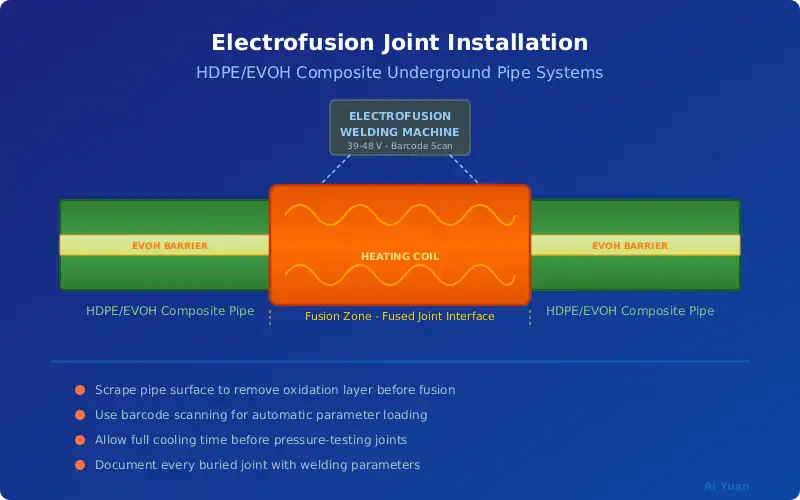
Clamps are usually understood as alignment tools, but they have a second role that matters just as much: they hold the joint rigid through the heating and, critically, the cooling phase. The melt pool inside the coupling is soft for a long time after the heating cycle ends. If the joint is disturbed or the pipe is moved into the trench during that window, the forming joint is stressed and its strength drops.
The practical rule is that the joint stays clamped and undisturbed for the full cooling time stated for the coupling, not just until the display says the cycle is complete. Cooling time is part of the weld, and crews that treat it as optional are the ones who come back to weeping joints.
A repeatable pre-weld routine
- Cut the pipe ends square and deburr them;
- Measure ovality at both ends and reround if needed, then remeasure;
- Scrape the pipe surface to clean bare material and mark the scrape depth;
- Clean with the approved wipes and let the surface dry;
- Support both pipe legs at matching height and insert into the coupling;
- Fit clamps on both sides and confirm alignment by eye and by gauge;
- Run the fusion cycle, then leave the joint clamped for the full cooling time;
- Record the joint, the operator and the cooling time in the weld log.
What the finished joint tells you
| Observation | Likely cause | Action |
|---|---|---|
| Melt has not emerged from both indicators | Insufficient scrape, wrong diameter fit or power issue | Cut out and redo the joint |
| Melt emerged heavily on one side only | Misalignment or ovality | Review supports and clamping, retrain crew |
| Joint moved during cooling | Clamps removed early | Enforce cooling time discipline |
| Repeated ovality readings | Coil storage or handling problem | Fix storage and paying-out practice |
| Weld log gaps | No recording routine | Make the log part of the joint procedure |
Electrofusion rewards crews that treat the joint as a small process rather than a single step. The welding unit handles the parameters; the crew handles the geometry. When alignment is real, ovality is measured and corrected, and clamps stay on through cooling, the joint passes pressure testing the first time and the weld log becomes evidence the site can show at handover.
Frequently asked questions
Can I weld without clamps if the pipe looks straight?
It is possible to complete a cycle without clamps, but nothing holds the geometry through cooling. Clamps cost little compared with the cost of digging a joint back up, so skipping them is never a saving.
How do I check ovality quickly?
Measure the pipe end across its widest and narrowest points with a caliper or an ovality gauge and compare the difference against the limit stated for the coupling. Reround, remeasure and only then weld.
Why keep the weld log if the joint passed testing?
Testing proves the joint on the day. The log proves the process behind every joint, which is what handover documentation and any later warranty discussion will ask for.
Luoyang Wohong Petrochemical Equipment Co., Ltd. supplies HDPE+EVOH composite fuel pipes, fittings and transition hardware for gas station underground piping programs, together with installation guidance and site support. Contact us for product selection and delivery planning.