
Short answer: composite fuel pipe handles renewable diesel, HVO and higher biofuel blends well, because the materials that make up the pipe wall were selected for hydrocarbon service rather than for a specific fuel label. The inner layer resists the fuel, the barrier layer limits permeation, and the structure carries load, so a site switching from conventional diesel to renewable diesel or a higher blend mostly needs to confirm temperature range, blend ratio and any cleaning step rather than replace the double-wall fuel pipe. The change is real, but it is a confirmation job, not a rebuild.
What renewable diesel and HVO actually are
Renewable diesel and HVO, hydrotreated vegetable oil, are produced by a different route than biodiesel but share the goal of a cleaner drop in fuel. They are chemically closer to petroleum diesel than to fatty acid methyl ester biodiesel, which matters for the pipe because the wall sees a hydrocarbon fuel rather than an ester. Higher blends simply raise the bio content of the fuel in the line, and the question for the piping is whether the wall, the seals and the barrier still perform at the ratios the site will actually run.
Why the pipe wall cares about the fuel, not the label
A double-wall fuel pipe does not read the pump label; it responds to what contacts its inner surface. The inner layer is chosen for resistance to the fuel it carries, and renewable diesel behaves like diesel at the wall. The real variables are temperature, blend ratio and any additive package, not the origin of the molecule. The E85 and biodiesel compatibility guide covers the ester side of the same question, and renewable diesel sits on the less aggressive end of that spectrum, which is why most sites can switch without changing the pipe.
What the barrier and layers handle
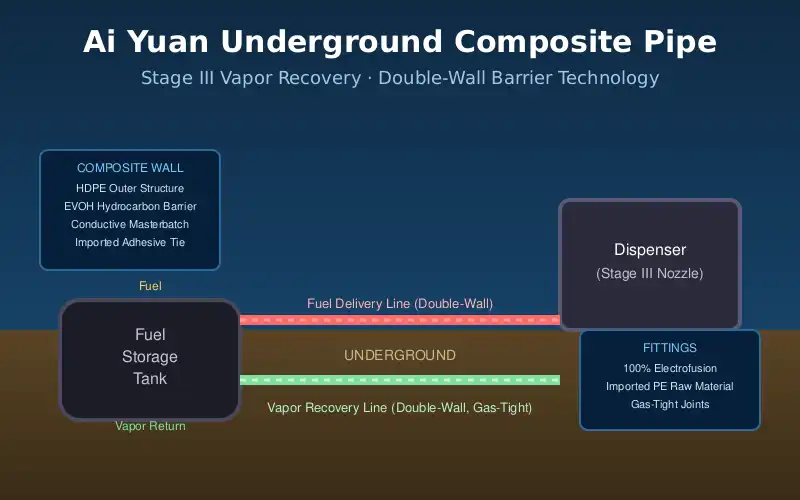
The value of a composite wall in biofuel service is the combination of layers. The inner layer resists the fuel, the barrier layer, often an EVOH type, limits hydrocarbon molecules from migrating through the wall over time, and a conductive layer keeps static in check. That stack is what lets the double-wall fuel pipe carry aggressive blends without the wall softening or weeping. The permeation and barrier guide explains how the wall blocks migration, and biodiesel blends are exactly the case where that barrier earns its place.
Higher blend ratios and what changes
As the bio content rises, the fuel can hold more water and act slightly more aggressively on some elastomers, so the seals and gaskets at fittings deserve the same attention as the pipe wall. The composite pipe itself is usually the least of the worries; the joints and the dispenser seals are where higher blends first show an effect. Confirming the fitting seals are rated for the blend is a short check that prevents a slow weep the pipe wall would otherwise have tolerated.
Storage temperature and what it asks of the line
Renewable diesel and biodiesel behave differently with temperature, and cold flow can matter in colder climates where the fuel thickens. The pipe operating range covers normal fueling temperatures, but a site that stores at the edge of that range should confirm the wall and the seals still perform. The table below summarises the confirmation a site should run before switching:
| Check | Why it matters | Action before switch |
|---|---|---|
| Blend ratio | Sets aggressiveness at wall | Confirm pipe rating covers the max blend |
| Fuel temperature | Cold flow and seal behaviour | Confirm wall and seal range |
| Fitting seals | Elastomer resistance to blend | Use seals rated for the blend |
| Cleaning step | Residual incompatible product | Flush line if changing fuel family |
| Monitoring | Early sign of weep | Keep interstitial monitoring live |
None of these is a pipe replacement; they are the checks that turn a fuel change from a worry into a signed off change.
Checks before switching a site to renewable diesel
A clean switch follows a short sequence that protects both the pipe and the equipment:
- Confirm the blend ratio and temperature the site will actually run, and compare them with the pipe rating;
- Check the fitting and dispenser seals are rated for the bio content, replacing any that are not;
- Flush the existing line if the new fuel is a different family from what was last carried, to avoid residue reaction;
- Keep the interstitial monitoring live so any weep at a seal shows up before it becomes a problem;
- Record the fuel change on the as built so later crews know what the line has carried;
- Watch the first fill and the first cold snap, because those are the moments a marginal seal reveals itself.
The last step is the practical one, because a fuel change that is watched through its first season is a change that stays uneventful.
Frequently asked questions
Is HVO safe in the same pipe as diesel?
Yes, because HVO is chemically close to diesel and the pipe wall was selected for hydrocarbon fuel service. A site blending HVO into diesel is not asking the double-wall fuel pipe to do anything new; the wall and barrier treat it like the fuel it already carried. The seals deserve a glance, but the pipe does not.
Do the fittings need to change for biofuel?
Often the seals do, especially at higher blends where some elastomers soften, but the composite pipe and electrofusion couplings do not. Swapping to blend rated seals at the joints is a small job compared with touching the buried line, and it is the part most worth checking.
Will renewable diesel shorten pipe life?
No, because renewable diesel is on the less aggressive end of the fuel spectrum and the wall was designed with margin. The blend ratio and the seals, not the pipe, are what decide longevity, so confirming those keeps the line on its original service life.
Fuel changes touch the whole station, and the sister site covers how onboard recovery and station vapor handling adapt as fuels and rules move on.
Luoyang Wohong Petrochemical Equipment Co., Ltd. supplies double-wall composite fuel piping, fittings and electrofusion accessories for gas station and fuel depot projects. Contact us for pipeline layout review and product selection support.