
Weak vapor return rarely announces itself as a number on a screen. It shows up as behavior: nozzles that click off early, dispensers that seem slow to serve, drivers who mention fuel smells, and a Stage III unit that runs gently because little is reaching it. The cause lives somewhere along a path that crosses the whole site, and the diagnostic task is to localize it with a plan rather than a guess.
Symptoms and how they group
The first information is the pattern. Symptoms at one dispenser point toward that branch: its vapor connection, its shear valve, its run back to the tank. Symptoms across every dispenser point toward the shared side: the tank vapor space, the main vapor riser, or the Stage III unit itself. Symptoms tied to unloading point at the coordination between the delivery and the vapor path. Grouping first saves half the walking, because the branch versus shared distinction is the biggest fork in the diagnosis.
The path from island to unit
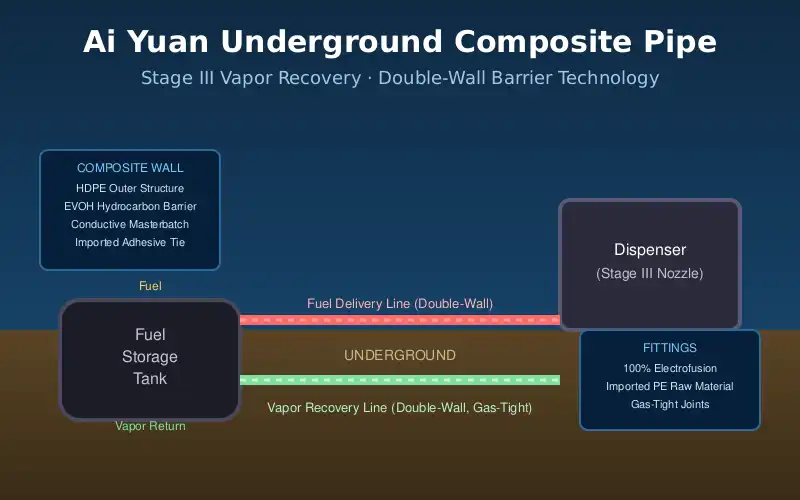
Vapor travels a long road: from the nozzle bellows through the dispenser vapor connection, along the branch vapor line, into the tank vapor space, out through the main riser to the Stage III unit. Every joint, dip and valve along that road can host a restriction, and the usual suspects have personalities. A kinked or flattened branch line behaves one way, a partially closed valve another, a liquid pocket in a sagging run a third. The design drawings, checked against what was actually buried, tell the diagnostician where the dips and junctions hide.
Field checks in a sensible order
The method moves from the cheap and visible toward the measured. Start where the symptoms are, work upstream, and let each step either clear a section or concentrate suspicion:
- Reproduce the symptom and record which dispensers, which fuels, which hour;
- Inspect the nozzle bellows, vapor shoe and dispenser connection for wear or blockage;
- Check the visible valves on the branch, and compare positions against the drawings;
- Look for liquid signs: wet spots, sumps holding product, evidence of sloped runs sagging;
- Measure at the branch test points, comparing pressures between islands;
- Finish at the unit side, where the shared path and the equipment meet;
- Write the chain of evidence down before opening anything or ordering parts.
Usual suspects and their signatures
| Suspect | Typical signature | Confirming step |
|---|---|---|
| Worn nozzle vapor shoe | One hose, symptoms at the nozzle | Swap or inspect the shoe |
| Partially closed branch valve | One island, others healthy | Position check against drawings |
| Liquid pocket in a sag | Worse after rain or cold mornings | Review slopes, drain the low point |
| Shared riser restriction | All islands, gradual onset | Compare test point pressures |
| Unit-side issue | All islands, unit runs oddly too | Unit logs and service line |
Handing over to the equipment side
When the site checks exhaust themselves, the remaining diagnosis belongs with the supplier, and the handover quality decides its speed. A written chain, symptoms grouped, sections cleared, pressures compared, turns the service visit from exploration into verification. Sites that keep this discipline find weak vapor return is rarely a mystery twice, because the record of the first diagnosis becomes the map for the next.
Frequently asked questions
Why do symptoms get worse after rain?
Rain is a probe for the weaknesses water can reach: sumps that hold liquid, low points that collect it, and penetrations that let it into the vapor path. A pattern that tracks the weather is itself diagnostic, and it usually points toward liquid management rather than mechanical wear.
Can a weak vapor return damage the dispensers?
Indirectly, yes: vapor that cannot return makes nozzles trip early, and repeated early trips frustrate drivers into workarounds that stress equipment. The system was designed as a circuit, and a restriction anywhere makes every component upstream work against a gradient it was not sized for.
Is it worth instrumenting the vapor lines permanently?
For most retail sites, test points plus a handheld gauge are enough, and permanent instruments add calibration duties that outlive their value. High-throughput sites with recurring vapor questions are the exception, and even there the annual comparison matters more than the daily graph.
Luoyang Wohong Petrochemical Equipment Co., Ltd. supplies double-wall composite fuel piping, fittings and electrofusion accessories for gas station and fuel depot projects. Contact us for pipeline layout review and product selection support.