
Stage III vapor return was designed to move vapor, but real forecourts send it liquid as well. Sloshing tanks, splashing dispensers and condensation inside cool pipework all put fuel where the drawings say vapor should be. Small amounts are normal and planned for; sustained carryover is a different animal, and it is one of the most common reasons a vapor return line that tested well on commissioning behaves badly a year later.
Where the liquid comes from
Three sources dominate. During unloading, vapor pushed back to the delivery truck carries fine droplets lifted off the tank surface, and at high transfer rates that mist thickens. At the dispenser, splash filling and hot-day foaming push liquid into the vapor path in pulses. Along the line itself, temperature swings condense lighter fractions out of the vapor, especially in long runs that pass through sun and shade. Each source on its own is modest; together they set the water and fuel load the line has to survive.
What carryover does downstream
Liquid in a vapor line does slow, unglamorous damage. It pools in low points and narrows the passage for vapor, which reads at the processor as rising differential pressure. It reaches components that were chosen for dry service and attacks seals and diaphragms not suited to constant wetting. In cold weather it concentrates the freeze risk at exactly the fittings with the tightest clearances. Sites that log differential pressure over time usually find the slope steepens after summer, when evaporation rates and splashing both peak.
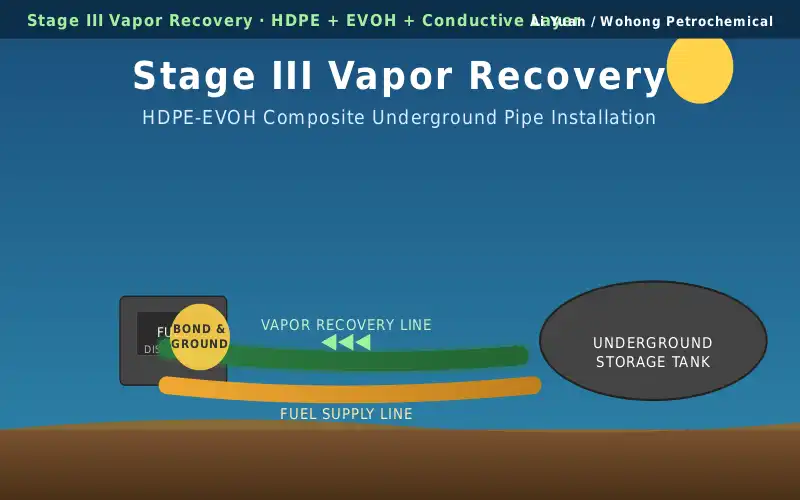
Design answers at the dispenser and the riser
The first line of defense is geometry. Drops and low points are given drain legs or sumps where liquid can gather and return, rather than sitting in the flow path. Slopes favor the tank, so condensate walks home instead of parking in the middle of the run. At the riser and ahead of sensitive equipment, a knockout or coalescing stage catches what geometry misses. None of this is exotic; it is the same physics that has protected vapor systems for decades, applied deliberately.
A maintenance sequence that keeps lines dry
- Walk the line profile and confirm every low point has a working drain or sump;
- Check and clean the knockout stage on the interval the duty justifies;
- Log differential pressure across the processor monthly and watch the trend;
- Inspect dispenser vapor fittings for wetting that suggests splash carryover;
- Before winter, drain accumulation points and verify no water pockets remain.
Equipment options and where each fits
| Element | What it catches | Where it belongs |
|---|---|---|
| Drain leg at a low point | Pooled fuel and condensate | Every sag in the vapor run |
| Coalescing stage | Fine mist from unloading pulses | Ahead of the processor inlet |
| Knockout vessel | Slugs from splash events | Riser and tank transitions |
| Slope correction | Condensate residence time | Retrofit on long flat runs |
| Wet-rated seals | Constant light wetting | Components in the vapor path |
Frequently asked questions
Is some liquid in the vapor return line normal?
Yes. Unloading mist and condensation cannot be fully engineered away, and Stage III systems are designed with that in mind. The problem is not the presence of liquid but accumulation without a place to go, which is what drains, slopes and knockout stages solve.
How can a site tell carryover is becoming a problem?
The trend line tells first: differential pressure creeping up between service intervals, or recovery efficiency dipping on hot afternoons. Physical signs follow, such as wetting at dispenser vapor connections or water found where drains are opened.
Does carryover affect the processor or only the piping?
Both, but in sequence. The piping accumulates first, and the processor inherits whatever passes through. Sites that keep the line dry usually find their processor maintenance intervals hold true to schedule instead of shrinking.
Luoyang Wohong Petrochemical Equipment Co., Ltd. supplies double-wall composite fuel piping, fittings and electrofusion accessories for gas station and fuel depot projects. Contact us for pipeline layout review and product selection support.