
The fuel retail map is quietly tilting toward smaller sites. Compact urban formats, rural single-island stations and franchise forecourts all trade on low land cost and simple operations, and they are multiplying in markets where big builds no longer pay. Their owners bring different expectations to underground piping: less engineering resource, less patience for complexity and a strong preference for buying decisions made in one meeting.
What makes small-station buying different
A large network project starts with drawings, a site survey and an engineering office; a small operator often starts with a quote request written between shifts. The run is shorter, the tank count lower and the vapor scope simpler, but the buyer has no specialist to decode options. Clarity has become the product: suppliers who present one sensible package with honest scope win these projects over those who present a catalog and a question mark.
What small operators actually ask for
| Priority | Why it matters to them | How good suppliers respond |
|---|---|---|
| One complete package | No one to coordinate between vendors | Pipe, fittings and vapor equipment quoted together |
| Plain scope description | No engineering office to interpret | Simple drawings and unambiguous lists |
| Predictable delivery | One crew, one mobilization window | Firm dates with local stock support |
| Installation guidance | Small contractors, varied experience | Field documentation and responsive support |
| Right-sized scope | No paying for features a four-pump site will not use | Options ladder instead of upselling |
How the market is adapting
Suppliers who watched this segment grow have adjusted their offer structure:
- Publish standard small-station designs that cover most single-tank and two-tank layouts;
- Quote packages with fixed fitting counts drawn from those designs;
- Ship complete kits, so nothing the crew needs is missing on pour day;
- Support the installer directly, since there is no main contractor between them;
- Keep upgrade paths open, because small stations grow when they succeed.
Why the big end of the market benefits too
Every improvement aimed at small buyers simplifies the large ones. Standard designs shorten network engineering, kits reduce site losses, and plain scope language shortens tenders everywhere. The segment is small in tons but large in lessons, and the suppliers learning from it are carrying those lessons back into their biggest contracts.
Choosing piping for a small site
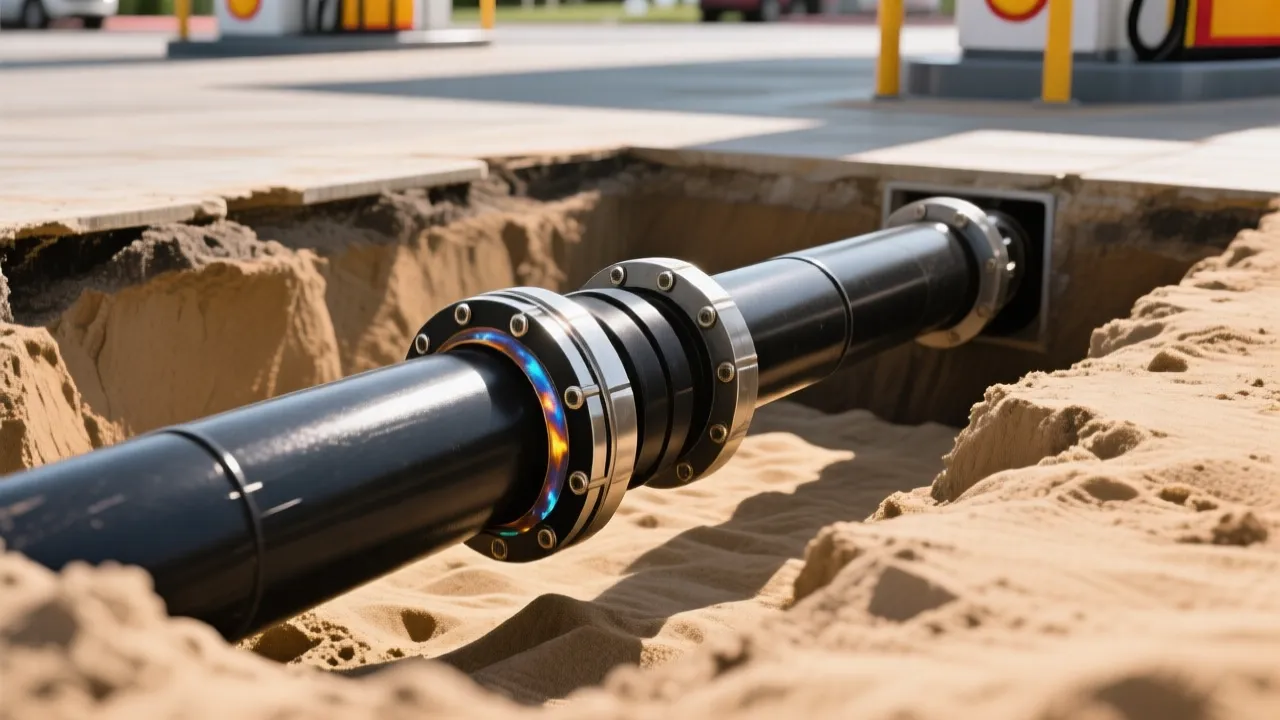
Small scale does not relax the engineering basics; it concentrates them. With fewer runs and fewer joints, every single connection carries a larger share of site risk, which argues for materials and fittings that tolerate imperfect conditions rather than ones demanding perfect crews. Flexible composite systems with electrofusion joints have become the default answer in this segment precisely because they concentrate quality in few, well-defined, checkable points.
Frequently asked questions
Are smaller stations skimping on vapor recovery?
The evidence points the other way. Regulation has reached even single-island sites in many markets, and suppliers report vapor equipment attaching to small-station piping orders at growing rates. What changes is the format: compact units, simpler routing and one-vendor delivery rather than omission of the scope.
Can one supplier genuinely cover everything a small site needs?
Increasingly yes, for piping and fittings certainly, and for vapor equipment when the supplier manufactures or partners deliberately. The honest boundary matters more than the claim: a supplier who says which third-party parts complete the package serves a small operator better than one who pretends the catalog has no edges.
What should a small operator check before signing a package?
Three things: that the fitting list matches the actual layout with a few spares included, that delivery dates are commitments rather than estimates, and that installation support has a phone number that answers. Small projects fail on coordination, not on technology, so the contract should pay attention to coordination.
Luoyang Wohong Petrochemical Equipment Co., Ltd. supplies double-wall composite fuel piping, fittings and electrofusion accessories for gas station and fuel depot projects. Contact us for pipeline layout review and product selection support.