
Short answer: electrofusion joints rarely fail because the fitting was bad; they fail because something in the preparation, alignment or fusion discipline was skipped, and the good news is that weld quality is testable before the trench closes. A fusion that joins like material to like material, made on a properly scraped and clean surface with the cycle respected to the second, is not the weak point of a composite fuel line, it is the strongest part of it. This article walks through the causes that keep showing up in the field, what each one looks like on the day, and the sequence of checks that separates a joint you can bury with confidence from one that will resurface as a leak report years later.
Why joints fail more often than pipes do
A pipe wall is a factory product: it leaves the line consistent, tested and uniform. A joint is a field product, assembled by a crew, in weather, on a schedule, out of components that met each other for the first time that morning. That asymmetry explains most of the statistics. When an underground line develops a leak, the pipe body is almost never the suspect; the investigation walks straight to the joints, and the joint that failed usually tells the same short story: the surface was not properly prepared, the ends were not dry or clean, the pipe was not clamped and aligned, or the fusion cycle was interrupted or guessed at. None of these causes is mysterious, and none is expensive to prevent, which is what makes joint failures so frustrating to read about after the fact.
The recurring causes and what each one looks like
Field experience keeps returning to the same short list of causes, and each has a recognizable signature at installation time:
| Cause | What it looks like on the day | What prevents it |
|---|---|---|
| Oxide layer not fully scraped | Glossy or shallow scraped bands, scraping done by eye | Depth marked tooling, full circumferential scrape |
| Contamination before fusion | Fingerprints, dust, rain or condensation on the fuse zone | Clean, dry, fuse immediately after scraping |
| Poor alignment or clamp gaps | Pipe ends not fully seated, visible mismatch | Proper clamps, cold slack, recheck seating |
| Interrupted fusion cycle | Power moved, cable kicked, cycle restarted mid way | Stable supply, cycle never restarted, log kept |
| Cooling discipline ignored | Clamps removed early, line moved before cool down | Full cooling time respected before any load |
The oxide layer problem deserves its own paragraph
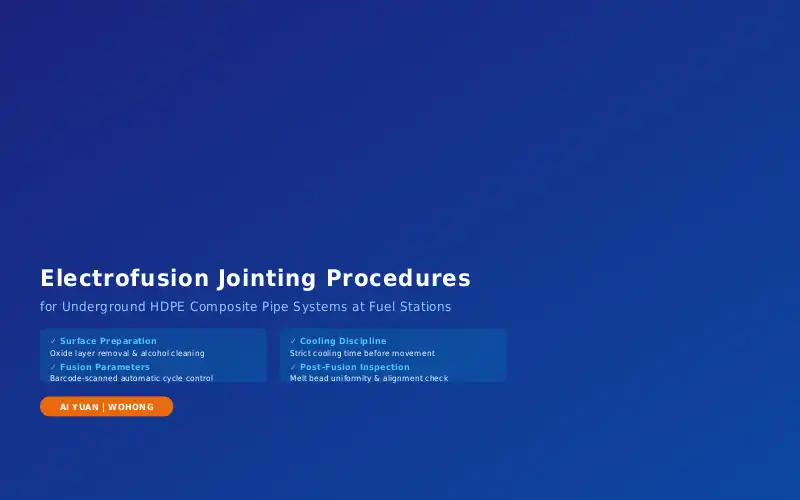
Thermoplastic pipe surfaces oxidize the moment they meet air, and that thin oxide skin does not fuse; it sits between the two surfaces like a release film. This is why scraping is the single most consequential act in the whole jointing process, and the one most often done carelessly. A proper scrape removes the oxide evenly around the full circumference and to the depth the fitting manufacturer specifies, with a tool that holds the depth rather than a blade held by feel. Equally important is what happens in the minutes after scraping: the fresh surface is at its best immediately and degrades with every minute of exposure to dust, moisture and handling. The discipline that separates good crews from unlucky ones is simple to state, which is scrape fully, clean once, and fuse at once. The same preparation logic runs through every topic where jointing decides the outcome, including the blend compatibility discussion, where the joint is asked the same chemistry question as the pipe wall.
How to test weld quality before backfill
Quality here is not a laboratory concept; it is a set of checks a crew can run in the minutes after each fusion, and the sequence is worth adopting as a card in the toolbox:
- Read the fusion record first: modern control boxes print or store cycle data, and an abnormal time, resistance trace or error code is the earliest and cheapest witness of a bad joint;
- Inspect the melt indicators: most couplings carry indicator pins or beads that must rise, and pins that never moved mean the fuse zone never reached temperature;
- Check seating and alignment while the joint is still clamped, because a joint that cooled under mismatch will hold that mismatch for its whole life;
- Respect the full cooling time before any handling, and record it, since cooling is part of the weld and not an optional pause;
- Pressure or tightness test the completed line, not per joint but as a system, and let the test pressure and duration follow the project specification rather than habit.
A joint that passes this sequence is known good, not hoped good, and the difference between those two words is exactly what a trench burial spends.
What good joint records look like
The strongest quality system on a piping project costs nothing: a notebook, or a phone, where every joint gets a line. Joint number, fitting batch, fusion data reference, scrape confirmation, cooling time, tester initials. Crews that keep this record build in a second benefit without trying: the act of recording forces the checks to happen, because nobody enjoys writing down a step they skipped. Years later, if a leak investigation ever visits the site, that record converts an archaeology exercise into a ten minute lookup, and it tells the investigator where to look first rather than where to dig everywhere. Buyers comparing suppliers sometimes focus only on hardware, yet the crew discipline around documentation and method is the part of the system that decides how the hardware performs.
When a joint should be cut out and remade
Not every suspect joint deserves a second chance, and knowing when to cut is part of quality. A fusion cycle that errored, a coupling whose indicators never rose, a joint that cannot show a record, or any joint on a line that failed its tightness test without an alternative explanation should be cut out and remade, not argued with. Cutting and remaking costs one coupling and an hour; a buried failure costs an excavation, a closure of the forecourt and an awkward conversation with everyone who trusted the installation. The arithmetic is so one sided that the only real decision is making it early, while the joint is still above ground and the crew is still on site.
Frequently asked questions
Can a joint that failed a pressure test be re fused in place?
No. A fusion is a one time event; the wire and the fuse zone cannot be reheated into a new weld. The correct response to a failed test at a joint is to cut out the coupling and the affected pipe ends and remake the joint with a new fitting, following the full preparation sequence. Attempting to reheat or patch a fused joint stores the problem underground.
Does cold weather change electrofusion quality?
Cold does not prevent good joints, but it changes the rules: surfaces cool and condense faster, materials stiffen, and cooling times lengthen, so the preparation window shrinks and the patience requirement grows. Crews working in cold conditions should shelter the joint zone from wind and moisture, follow the fitting documentation for any adjusted parameters, and let the cooling discipline stretch rather than compress.
How long should a joint cool before the line is tested or moved?
Long enough to match the fitting documentation, which is the only number worth following, and the general rule worth remembering is that cooling is part of the weld, not a pause after it. Moving a line, removing clamps or stress loading a warm joint can distort the fuse zone while it is still forming, and the damage never shows from the outside.
A tight joint underground keeps the fuel where it belongs, and the emission troubleshooting guide from the sister line shows why that same tightness decides how the vapor recovery system performs above it.
Luoyang Wohong Petrochemical Equipment Co., Ltd. supplies double-wall composite fuel piping, fittings and electrofusion accessories for gas station and fuel depot projects. Contact us for pipeline layout review and product selection support.