
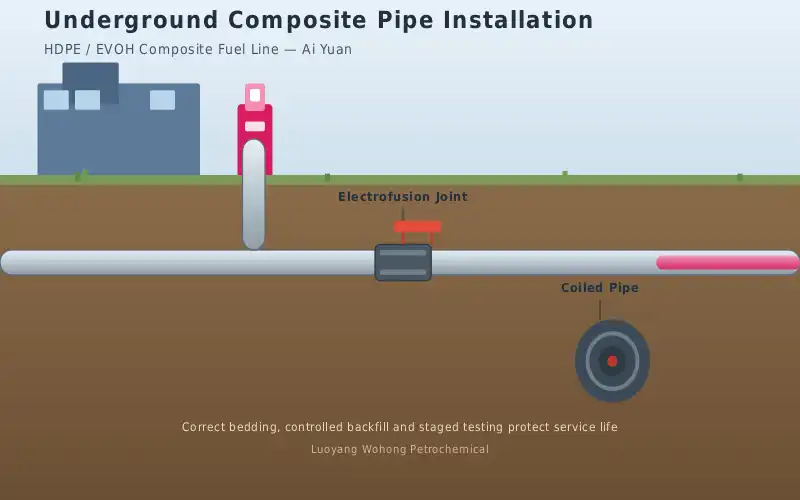
An electrofusion joint is made in minutes and lives for decades, which is why the inspection window matters so much. Once the trench closes, every judgement about the joint is retrospective and expensive. The crews with the best long-term records are not the ones with fanciest equipment; they are the ones who look at the joint carefully before the backfiller arrives.
What a sound joint shows on the day
Fusion leaves evidence. Both melt beads should rise evenly around the witness holes, roughly equal on each side, without weeping molten material down the pipe. The coupling should sit square on the barrel, and the alignment clamps should come off only after the full cooling time has passed. Any joint where a bead failed to rise, or where one side surged while the other stayed flat, is treated as suspect regardless of what the control box reported. The box confirms the cycle ran; the beads confirm the joint formed.
The details that quietly ruin joints
Most weak joints trace back to preparation rather than the coupling itself. Scraped surfaces that were touched with bare hands afterward, surfaces not cleaned with the intended fluid, pipe ends not fully inserted to the depth marks, and cold fusion started without temperature conditioning are the recurring themes. None of them look dramatic at the time. All of them shorten the margin the joint carries into service.
Verifying before burial
The acceptance sequence that works on real sites is short and repeatable:
- Inspect both beads and the coupling position before releasing the clamps;
- Confirm insertion depth marks are still visible against the coupling ends;
- Repressure the section after cooling and hold it through the agreed window;
- Photograph the joint with the depth marks visible for the as-built record;
- Log the fusion printout or control box reading against the joint number.
Matching symptoms to causes
When something looks wrong, the pattern usually points to a specific habit. The table below covers the cases crews meet most often.
| Symptom at the joint | Likely cause | Response before backfill |
|---|---|---|
| One bead missing entirely | Current path or clamp issue | Cut out and refuse the joint |
| Melt wept from witness hole | Overheating or wrong cycle data | Cut out and refuse the joint |
| Coupling visibly off-square | Insufficient clamping | Re-clamp, cool, re-evaluate or redo |
| Beads fine, test loses pressure | End seal or insertion fault | Locate by section, redo the joint |
| Beads fine, record missing | Paperwork gap only | Reprint or re-log before covering |
Records as the second layer of quality
Photographs and fusion printouts do not make a joint stronger, but they make quality discussable. When a section shows a problem years later, the record narrows the suspects from a trench length to a joint number. Suppliers who receive disciplined records also learn which couplings, which crews and which conditions produce the best results, and can adjust guidance accordingly. Quality, in practice, is a loop between the trench and the office.
Frequently asked questions
Can a doubtful joint be left in the ground if the pressure test passes?
A pressure test proves the joint holds today, not that it carries margin for decades. Where beads or records raise doubt, the honest answer is to cut the joint out and fuse again while the trench is open, because the cost difference between now and later is enormous.
How long should cooling last before clamps come off?
The full time stated for the coupling, without shortcuts. Cooling time is part of the joint, not an afterthought, and releasing clamps early is one of the few preparation faults that no later inspection can compensate.
Do joints need retesting after backfill?
The pressure test is done before and confirmed after the initial surround is placed, since backfill can shift a poorly supported joint. Once the protective cover is compacted and the test holds, the line is ready for final closure.
Luoyang Wohong Petrochemical Equipment Co., Ltd. supplies double-wall composite fuel piping, fittings and electrofusion accessories for gas station and fuel depot projects. Contact us for pipeline layout review and product selection support.