
An electrofusion coupling is a modest component, but the joint it makes carries the whole philosophy of composite piping: the fitting does the joining, and the preparation does the trusting. Nearly every premature electrofusion failure traced back to a trench turns out to have started on the surface of the pipe, minutes before the weld cycle began.
What the oxidized layer actually does
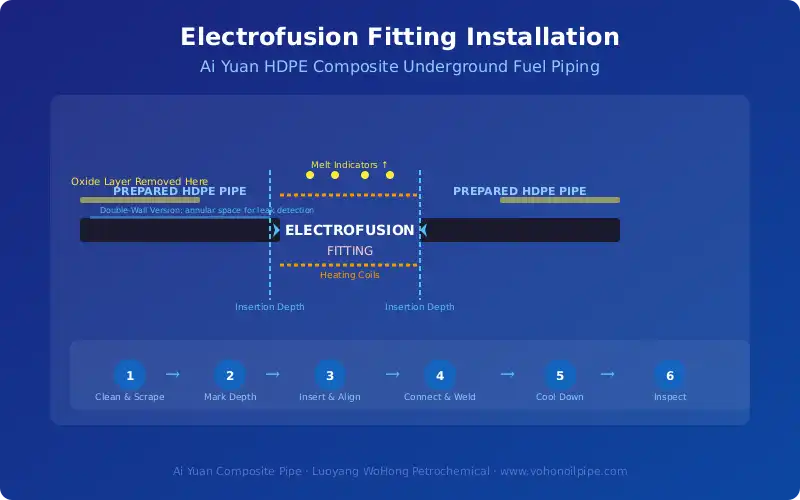
Composite pipe surfaces carry an oxide layer that fusion energy cannot reliably cross. Left in place, it acts like a barrier film between the fitting and the material underneath, producing a joint that passes the initial test and drifts apart over years. Scraping removes that layer and exposes fresh material, which is why the scrape is the single most valuable minute in the whole procedure. A joint is only as good as the surface beneath it at the moment the current flows.
The preparation sequence that works every time
Discipline here is not talent; it is sequence. The crews whose joints never come back follow the same short ritual on every single coupling, whether it is the first of the day or the fortieth:
- Mark the insertion depth on the pipe so the coupling position is verifiable before the weld starts;
- Scrape the full contact zone with a proper tool until the entire marked band is uniformly fresh;
- Wipe with the recommended cleaning agent and let it flash off completely before assembly;
- Assemble without touching the prepared surface, then clamp so alignment is held, not hoped for;
- Record the fusion parameters and let the joint cool undisturbed for the full stated period.
None of these steps is difficult. What makes them powerful is that they happen every time, on every joint, without shortcuts on the days the schedule feels tight.
The mistakes that show up years later
Field failure reports repeat the same handful of stories: a joint assembled after rain without re-cleaning, a scrape done with a blade too dull to cut cleanly, a coupling pushed into position after the wipe and dragged along dirty ground, a cooling period shortened because the trench needed backfilling before lunch. Each shortcut saves seconds and spends years of margin. The table below pairs the common mistakes with what they cost.
| Shortcut taken | What it saves | What it risks |
|---|---|---|
| Skipping the scrape | Two minutes | A barrier layer under the whole joint |
| Touching the prepared band | A moment of care | Contamination the weld cannot cross |
| Fusing without clamps | Clamp rental | Misalignment stress locked into the joint |
| Shortening cool-down | Schedule pressure | A weak joint buried under backfill |
| Welding in rain without shelter | Waiting time | Moisture in the fusion zone |
Making discipline easy is a management job
The crews that keep this standard are not more heroic; their supervisors made it easy. Scrapers are sharp and replaced on schedule, cleaning agent is on the truck, clamps are ordered with the fittings, and the paperwork records each joint so nobody is tempted to hurry. Preparation discipline is one of the few areas where a supervisor can buy decades of reliability with a checklist and a hardware budget.
Frequently asked questions
Can a prepared pipe end be left overnight before fusing?
Best practice is to fuse the same day, and ideally within hours. Freshly scraped material re-oxidizes, and dust settles on prepared surfaces no matter how clean the site. If the schedule forces a delay, re-scrape and re-wipe before assembly.
Is a field-cut end prepared differently from a factory end?
The surface ritual is the same, but field cuts deserve extra attention to squareness and burr removal before scraping. A square, clean cut makes the insertion depth marks meaningful and the coupling seating even.
How do I know a scrape was thorough enough?
The entire marked contact band should show uniform fresh material with no glossy patches of the original surface anywhere inside it. If any sheen remains, the oxide layer is still there and the scraper, not the crew, is usually the problem.
Luoyang Wohong Petrochemical Equipment Co., Ltd. supplies double-wall composite fuel piping, fittings and electrofusion accessories for gas station and fuel depot projects. Contact us for pipeline layout review and product selection support.