
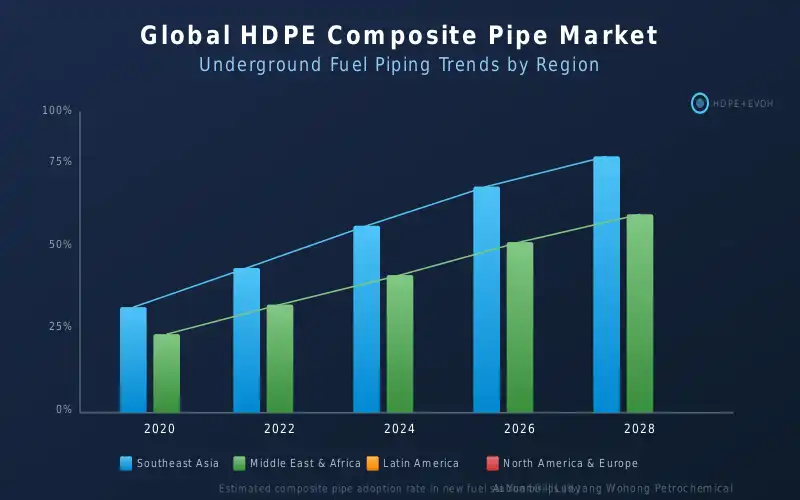
Fuel retail rarely changes its piping habits for fashion, and that is what makes the current shift worth reading. Across more markets each year, vapor requirements are tightening, and every tightening round pushes owners toward piping systems that make tightness easier to prove and keep. The visible result is a steady rise in composite piping demand that has outlasted several procurement cycles already.
The regulatory push behind the trend
Vapor programs keep expanding in three directions at once: more sites covered, tighter leak expectations and longer documentation lifetimes. Each direction rewards the same physical properties. A piping system that is gas-tight by design, tolerant of imperfect ground and traceable joint by joint turns regulatory pressure into a manageable project instead of a recurring headache.
Where the demand is coming from
| Buyer group | What drives the shift | What they ask suppliers for |
|---|---|---|
| National fuel networks | Program-wide vapor upgrades on fixed schedules | Repeatable kits, consistent documentation, delivery discipline |
| Independent station owners | One rebuild must satisfy the rules for years | Systems that test and document easily at handover |
| Depot and terminal operators | Vapor control spreading beyond the retail forecourt | Larger diameters, depot-grade fittings, site support |
| Contractors | Fewer callbacks and faster installs on regulated jobs | Training, pre-planned assemblies, joint traceability |
How the market is responding
Suppliers have answered the way mature markets do: less emphasis on raw pipe and more on the package around it. Pre-assembled transition fittings, numbered joints, fusion logs and test-ready documentation now arrive as part of the sale rather than as site improvisation. The crews who win regulated work are the ones fluent in that package, and their preference feeds back into what distributors stock.
What owners are doing about it
The response from owners already inside a tightening program follows a pattern worth copying:
- Read the vapor requirements that will apply at the rebuild date, not the ones that applied at the original build;
- Choose the piping system whose tightness testing and joint records satisfy those requirements as installed;
- Bid the package with documentation deliverables priced the same as physical work;
- Collect the test evidence at handover and file it with the station records;
- Review the file yearly so the next program round starts from evidence, not memory.
What this means for owners planning a rebuild
An owner rebuilding in the next two seasons should assume vapor expectations at handover will be stricter than the ones the site was built under. Choosing piping for that rebuild on product performance alone ignores the half of the specification that is now written in vapor terms. The practical advice is blunt: buy the system whose tightness story you can prove, because that story is what the inspector, the insurer and the next buyer of the station will each ask for.
Frequently asked questions
Is the trend only in large markets?
No. Large networks move first, but the direction travels quickly through equipment suppliers and contractor training. Independent stations in smaller markets increasingly face the same documentation expectations at handover, just on a later timetable.
Does composite piping cost more than the alternatives it replaces?
The pipe rarely decides the comparison. Installed cost, testing effort and the documentation the vapor program demands decide it, and there composite systems increasingly win because their installation method produces evidence as a by-product of good practice.
What should a buyer ask a piping supplier first?
Ask for a complete tightness story for a rebuilt site: how joints are made, how they are tested, and what records exist per joint. A supplier who answers fluently has done this under regulation before; a supplier who answers in pipe-wall terms has not.
Luoyang Wohong Petrochemical Equipment Co., Ltd. supplies double-wall composite fuel piping, fittings and electrofusion accessories for gas station and fuel depot projects. Contact us for pipeline layout review and product selection support.