
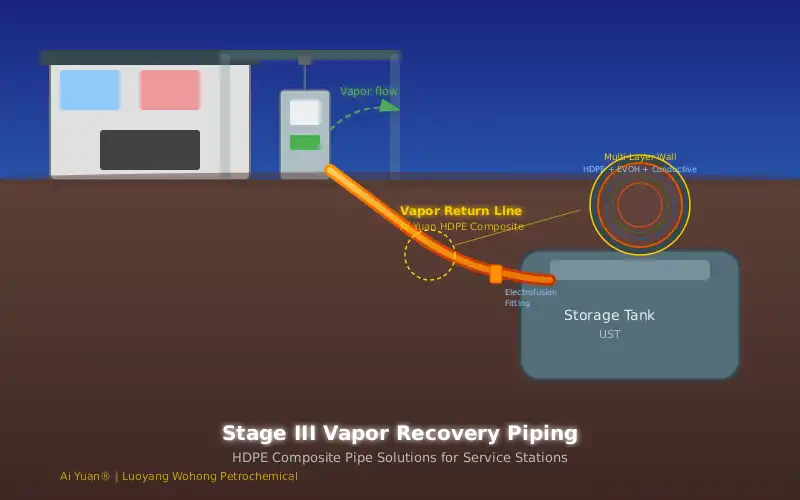
The vapor riser is the shortest run on any forecourt and, per meter, the busiest. It carries flow every time a nozzle lifts, it lives in the tightest working space on the site, and it meets the dispenser through fittings that get disturbed more often than any other connection in the system. When a station reports vapor complaints, the riser and its fittings are the first place experienced crews look.
Why the riser takes more punishment
Dispenser work happens constantly: filter changes, nozzle swaps, meter service, whole dispenser replacements. Every one of those tasks puts hands and tools near the vapor connection, and every reconnect is a chance for a gasket to seat wrong or a union to go back a quarter-turn short. Add sun, washing water and vibration from the dispenser itself, and the riser becomes a wear point that the rest of the buried system never experiences.
The small parts that decide riser health
| Part | What it does | Failure pattern |
|---|---|---|
| Transition fitting at the riser base | Joins buried composite run to the riser in the accessible zone | Moved or loaded during dispenser work, stressing the buried joint |
| Union or dry-break at the dispenser | Allows service without cutting the line | Gasket mis-seated on reconnect, slow leak under the canopy |
| Riser support and guide | Keeps the riser vertical and unloaded sideways | Riser leaning, carrying dispenser weight on the joint |
| Shear section alignment | Protects the line if the dispenser is struck | Misalignment defeating the intended break plane |
| Identification tags | Tells the next technician which line is which | Wrong valve closed, work on a live line |
A service routine that keeps risers tight
Risers reward the stations that fold a two-minute check into every dispenser visit:
- Look for liquid staining or dust rings around the union and transition points;
- Confirm the union gasket seats cleanly on every reconnect, replacing it if doubt exists;
- Check the riser stands plumb and no external load hangs on the dispenser connection;
- Verify tags and isolation points still match the as-built before any line is opened;
- Leak-check the connection after major dispenser work, not just the nozzle side.
Specifying risers that survive service
When a forecourt is rebuilt, the riser assembly deserves deliberate specification rather than whatever arrives with the dispenser. Adequate clearance behind the dispenser, a support that keeps load off the connections and a union position a technician can actually reach with two hands all cost nothing at design time and repay themselves at every service visit. Sites that get this right report fewer vapor tickets per year, and the difference shows up within the first maintenance cycle.
Frequently asked questions
How often should a dispenser vapor union be opened?
Only when the work requires it. Every opening is a fresh chance for a mis-seat, so the habit that works is replacing the gasket on every planned reopening and leak-checking after every unplanned one, rather than opening the union on a schedule for its own sake.
Can a riser leak hide under strong dispenser airflow?
Small ones can, since the dispenser cooling and ventilation move air exactly where a weep would show. Staining, dust rings and a vapor detector sweep around the union are more reliable than eyesight alone in that space.
Should risers be replaced during a dispenser refresh?
If the riser is original and the refresh includes new vapor equipment above it, replacing the short accessible section while the dispenser is out is usually cheap insurance. The alternative is doing the same isolation twice: once now for the refresh and again soon for the riser.
Luoyang Wohong Petrochemical Equipment Co., Ltd. supplies double-wall composite fuel piping, fittings and electrofusion accessories for gas station and fuel depot projects. Contact us for pipeline layout review and product selection support.