
Short answer: this is not a contest with one winner, because the two methods solve different problems. Electrofusion rebuilds a continuous, welded, permanent wall and belongs wherever the line is buried and never meant to be opened; mechanical fittings clamp components together and belong wherever the system needs a transition, an accessible connection or a component that will one day be serviced. Well designed fuel station piping uses both, each in the place where its nature is an advantage, and the design mistake to avoid is not choosing the wrong brand but putting either method where the other one belongs.
Two philosophies of joining pipe
The difference between the methods starts in what each one is trying to be. An electrofusion joint melts the pipe wall and the fitting into one continuous piece of material, so the finished connection is a pipe with no seam in principle; its strengths are permanence, a leak path that is molecular rather than mechanical, and the way it restores barrier layers across the connection on pipe designed for it. A mechanical fitting grips the outside of the pipe with a seal and a restraint; its strengths are speed, reversibility, and the fact that it connects things that were never meant to melt together, such as composite pipe to steel equipment or pipe to a dispenser. One philosophy says the joint should disappear; the other says the joint should be findable. Neither is wrong, and the whole skill is in the placement.
Where electrofusion earns its place
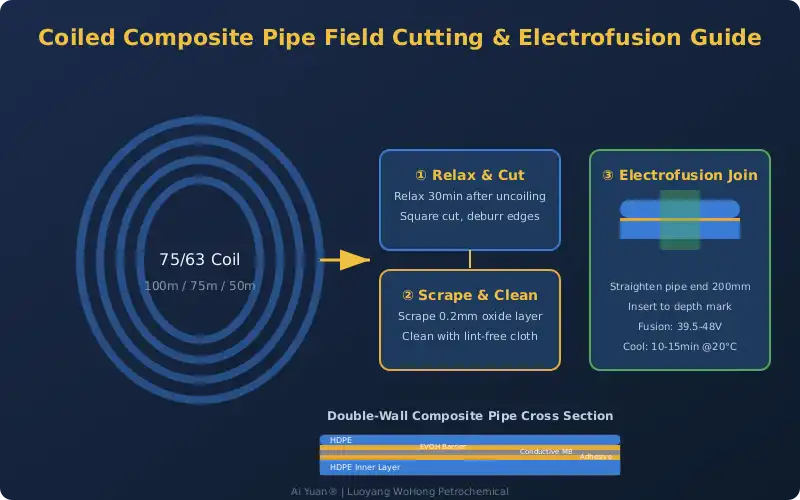
Buried runs are electrofusion territory, and the reasons stack up the deeper you go. A welded joint has no gasket to age, no bolts to relax and no clamp to rely on, which matters when the only way back to the joint is an excavation. It restores the full wall structure, including the vapor barrier, on composite systems built with one, so the buried line stays a continuous barrier rather than a wall with open doors at every connection. It also resists the things soil does to assemblies over decades: settlement loads, ground water, temperature cycling. The trade is discipline and access, since electrofusion asks for clean scraped surfaces, stable power, correct clamping and full cooling, and it asks to be done once, properly, because a buried weld is a permanent decision. That is exactly the right trade for a line that will spend thirty years under a forecourt, and the underground composite pipe systems are designed around it.
Where mechanical fittings earn their place
Above ground, at transitions and at anything a service technician may need to open, mechanical fittings are the honest choice. The dispenser connection, the tank fittings, the transitions from composite to steel or to flexible drops, the isolating points on a vapor line: these are places where the system wants to be taken apart someday, or where it must meet hardware that does not fuse. A mechanical connection installed where it is accessible turns future service from an excavation into a wrench task. The trade is that a mechanical joint depends on a seal and a gripping mechanism, which means it depends on correct assembly torque, on the condition of the seal, and on the pipe end being prepared to specification. The table below puts the two philosophies side by side:
| Aspect | Electrofusion | Mechanical fittings |
|---|---|---|
| Nature of the joint | Welded, continuous wall across the connection | Sealed and restrained clamp on the pipe |
| Best location | Buried runs, permanent lines, barrier restoration | Transitions, dispenser and tank connections, service points |
| Leak path over time | Molecular level, effectively none when made correctly | Depends on seal condition and assembly quality |
| Skill and discipline | Surface prep, clamping, cycle and cooling discipline | End preparation, torque, seal handling |
| Rework | Cut out and remake, no second fuse | Can be opened and remade with new seals |
| Future access | None by design, and that is the point | Designed to be opened |
Deciding the method for each point on your site
Method selection stops being a debate when the site is walked point by point, and the walk fits on one page of checklist:
- Mark every connection on the piping drawing and classify it: buried permanent, buried but transitional, or above ground and accessible;
- Assign electrofusion to every buried permanent joint, with no exceptions that save an hour today and cost a trench later;
- Assign mechanical fittings to transitions and to any point the design expects to be opened for service;
- Count the mechanical joints honestly, because each one is a future service item, and fewer, well placed ones beat many convenient ones;
- Write the assignment into the installation specification so the crew on site inherits the logic, not a decision they have to guess at.
Mixing the two without weakening either
Real stations use both methods, and the joints where they meet deserve particular respect, because a transition inherits the requirements of both philosophies at once. The composite side must be prepared and assembled exactly as the fitting documentation demands, the steel or equipment side must present a clean, undamaged sealing surface, and the assembly must be supported so that neither side carries bending loads it was not designed for. Transitions also deserve to be logged like electrofusion joints, with the same record discipline, because a transition is exactly the place a future investigation will want to find quickly. Sites that treat transitions as first class joints, rather than as an afterthought between two systems, are the ones that never meet them again except on paper. The barrier layer discussion explains why transition placement matters even more on barrier pipe.
Frequently asked questions
Can mechanical fittings ever be buried?
Some products are made and approved for buried use, and where the documentation allows it they are legitimate, but the design intent matters more than the permission. A buried mechanical joint is a service item nobody can service, so the better rule is that burial is electrofusion territory, and mechanical connections live where hands can reach them. When a buried mechanical connection is unavoidable, it belongs in an accessible chamber, not in plain soil.
Is electrofusion always the stronger joint?
On buried composite lines, yes in the sense that matters: it is the joint least likely to change over decades, because it has no seal to age and no clamp to relax. That does not make it the right answer everywhere, since a permanently welded connection at a dispenser would convert every future service call into an excavation. Strength and suitability are different questions, and each method wins one of them.
What about repairs on a line that is already in service?
Repairs are where the two methods meet most often, and the logic stays the same: cut back to sound pipe, remake the buried joint by electrofusion, and use mechanical connections only if the repair introduces a component or an access point that the design genuinely wants. A repair is also the best moment to fix the record keeping, because a documented repair today is the investigation file of tomorrow.
The piping side decides where vapor and fuel can escape, and the vapor recovery unit from the sister line handles the vapor that leaves the tank by design, which is why the two systems are always specified together.
Luoyang Wohong Petrochemical Equipment Co., Ltd. supplies double-wall composite fuel piping, fittings and electrofusion accessories for gas station and fuel depot projects. Contact us for pipeline layout review and product selection support.