
Short answer: bonding and grounding checks for a composite fuel pipe installation are the steps that stop static charge and stray current from finding a spark path at the line. Because the pipe wall is non conducting, the conductive layers, fittings, metallic risers and nearby equipment must be deliberately connected to a common ground before product flows. The checks are continuity across every joint, a verified bond to the tank and dispenser system, and a grounding electrode tested to the specified resistance, all recorded on the same day as the work.
Why a non conducting pipe still needs grounding
A double wall composite fuel pipe carries fuel safely because its wall does not conduct, but that same property means static generated by flowing product has nowhere to dissipate through the pipe itself. The conductive tracer or shielding layer built into the system is there precisely to give that charge a safe path, and it only works if it is bonded end to end and tied to ground. Skipping the checks leaves a non conducting line that can still build a charge at a riser or fitting, which is exactly the condition nobody wants near fuel. Grounding here is not optional paperwork, it is part of the product working as designed.
What actually gets bonded
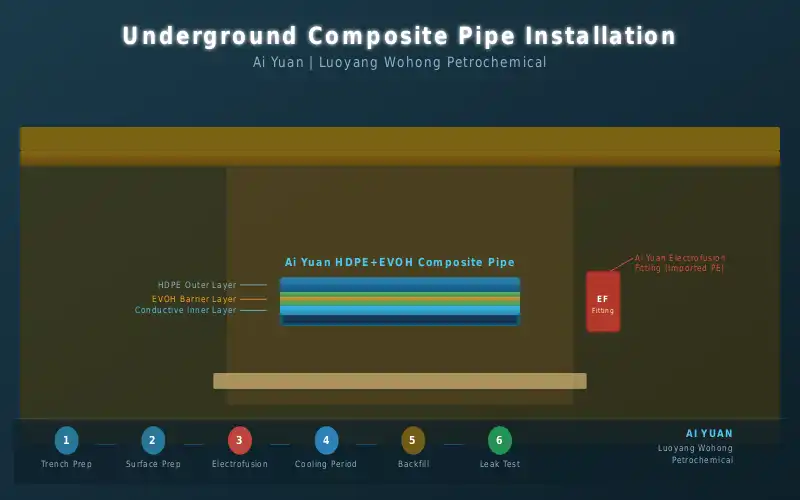
The bond chain runs through every piece that could carry or collect charge: the pipe conductive layer at each joint, the electrofusion fittings, the metallic risers where the line meets above ground equipment, and the tank and dispenser structure the line serves. Each connection must be made with the right clamp and verified, because a single open joint breaks the chain and isolates a section. The conductive layer guide explains how the shielding is built into the pipe, and the installation bond is what turns that built in feature into real protection on site.
Continuity checks across joints
Before backfill, continuity is confirmed across every joint so the conductive path is unbroken from tank to dispenser. A simple resistance reading across each coupling shows whether the bond is made, and any reading outside the expected range is reworked rather than noted. This is the check most often rushed, and it is the one that matters most, because a hidden open bond is invisible once the trench closes. The discipline mirrors what careful seismic sites require, where every restrained joint is verified rather than assumed.
Grounding electrode and resistance
The bonded system terminates at a grounding electrode driven to the specified depth and tested for resistance to earth. The target figure follows the site standard and the local soil, and a high reading means the electrode is not doing its job, so it is lengthened, enhanced or relocated before the line is accepted. A good ground is what lets any collected charge bleed away safely instead of building toward a spark, and the test result is the proof the work was done. Owners weighing install quotes should treat a documented ground and bond test as a baseline requirement rather than an optional extra, because the buyer comparison guide shows that install conditions, not just product price, decide how the line performs over time.
The checks as a sequence
Collating the steps makes the handover to the crew obvious, and most omissions trace to one of these being skipped:
| Step | Check | Why it matters |
|---|---|---|
| Bond the chain | Connect conductive layer, fittings, risers | Gives static a continuous path |
| Verify continuity | Resistance reading across each joint | Catches an open bond before backfill |
| Ground the system | Electrode to specified depth | Bleeds charge safely to earth |
| Test resistance | Measure ohms to earth | Proves the ground actually works |
| Record results | Log readings with the as built | Makes the protection auditable later |
None of the steps is exotic, which is exactly why they get dropped under schedule pressure. The sites that hold the line are the ones that treat the checklist as a gate and refuse to close the trench until the meter says the bond is good.
Steps that keep the installation safe
The protection plan reduces to habits any competent crew can keep:
- Confirm the conductive layer is exposed and cleaned at every joint before the coupling is made, because a dirty contact is an open contact;
- Bond the pipe chain, fittings and metallic risers to the tank and dispenser system as one continuous path;
- Measure continuity across each joint and rework any reading outside the expected range before backfill;
- Drive the grounding electrode to the specified depth and test its resistance to earth, enhancing it if the reading is high;
- Tie the vapor and fuel sides to the same ground reference so charge cannot build between systems;
- Record every reading on the same day alongside the as built, so the protection can be audited for the life of the line.
The last step is the one that turns a safe install into a provable one. A recorded bond is what lets an operator show the line was protected rather than hope it was.
Frequently asked questions
Does a plastic fuel pipe need grounding at all?
Yes, because the pipe wall does not conduct, the charge it cannot carry must be handled by the conductive layer and the bond to ground. Without that path, static from flowing fuel can build at a riser or fitting and create a spark risk. Grounding is part of how the non conducting pipe stays safe.
When should continuity be checked?
Before backfill, while every joint is still open and accessible. A continuity reading taken after the trench is closed is useless, because the one joint you cannot reach is the one that failed. Same day checking is the only checking that counts.
What if the ground resistance reads high?
Lengthen or enhance the electrode, or relocate it to better soil, and retest until it meets the specified figure. A high reading means the charge has nowhere safe to go, so the system is not grounded in any useful sense until the number comes down.
Static safety ties into the whole fuel system, and the sister site covers how the compliance side of station design protects operators and the public.
Luoyang Wohong Petrochemical Equipment Co., Ltd. supplies double-wall composite fuel piping, fittings and electrofusion accessories for gas station and fuel depot projects. Contact us for pipeline layout review and product selection support.