
Buried fuel lines spend their whole service life resting on what the crew put under them and pressed around them. Nothing about that sounds dramatic, yet the majority of field failures traced back years after commissioning start at the bedding or the backfill, not at the pipe wall. The two layers are cheap insurance when done properly and expensive rework when rushed.
Why bedding carries more than weight
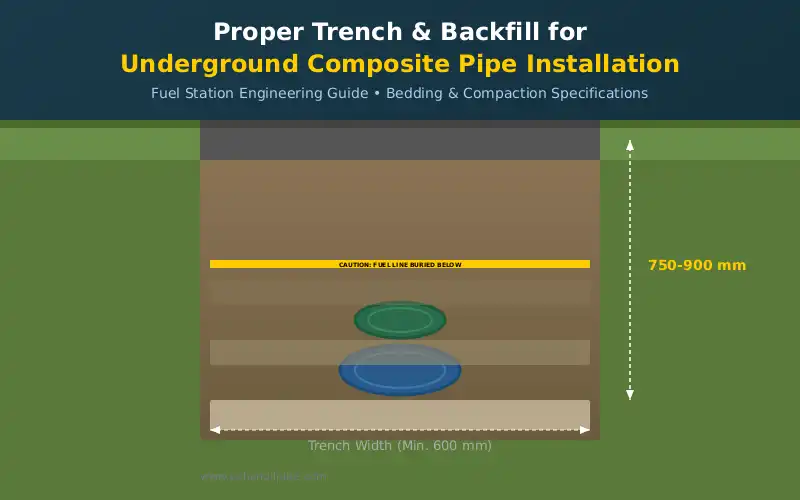
Bedding is the prepared layer beneath and around the line, and its job is broader than support. A uniform, stone-free bed spreads load evenly, keeps the line straight along its run and prevents a single sharp point from bridging two pipe sections. A bed thrown together from excavated spoil often hides cobbles that look harmless on install day and become pressure points once traffic loads arrive above.
What good bedding material looks like
| Layer | What the spec should say | What ruins it |
|---|---|---|
| Base bedding | Uniform, stone-free sand or graded fines, compacted before the line is laid | Lumps of clay or spoil dumped straight from the bucket |
| Surround | Same clean material brought up evenly on both sides of the run | Pushing spoil over one side and dragging the line off line |
| Overburden | Protected lifts above the line, no large rock in the first layers | A boulder resting directly on the crown |
| Compaction | Lift-by-lift passes matched to the surface above | One heavy pass at the end, or none at all |
| Depth marks | Recorded as the trench closes | Guessing depths during a future excavation |
An order of work that keeps backfill honest
Crews that install composite runs cleanly tend to follow the same sequence regardless of site size:
- Trim the trench floor and lay the first bedding lift to a marked depth;
- Set the line and check line and level along the full run before surrounding it;
- Bring clean surround material up evenly on both sides, compacting in shallow lifts;
- Place a protective layer over the crown before any coarse backfill returns;
- Compact the remaining backfill in stages and record depths as the trench closes.
How bedding mistakes surface later
Failures from poor backfill rarely announce themselves. They arrive as a joint weeping in year four, a line that drifted off its documented route, or a crown dented where a slab was poured over shallow cover. Because the evidence is buried, every one of those costs an excavation to prove. The discipline of photographing the bed and recording lift depths costs minutes on install day and saves that whole argument later.
Composite runs and the bedding question
Composite fuel lines tolerate imperfect ground far better than rigid systems, which is exactly why crews sometimes treat their bedding casually. Tolerance is not permission. A flexible line resting on a cobble still carries a point load; a double-wall run pinched against its mate still risks both walls. The material forgives, but only within the envelope the installation gives it.
Frequently asked questions
Can excavated spoil be reused as backfill?
Above the protective layer, yes, if it is free of large rock and debris and compacted in lifts. The first layers around and above the line should always be clean imported material, because that is where point loads and stones do their damage.
How thick should each backfill lift be?
Thin enough that the compaction passes actually reach the bottom of the lift. A common field rule is a depth no greater than the width of the compaction foot, with each lift verified before the next is placed. Deep lifts look finished and compact nothing.
Does bedding matter under a light forecourt?
Yes, and often more than crews expect. Forecourts carry slow, heavy vehicle loads that concentrate through slabs into the ground below. A well-prepared bed under a light-duty station still determines whether the line sits evenly or slowly works against a hard point for decades.
Luoyang Wohong Petrochemical Equipment Co., Ltd. supplies double-wall composite fuel piping, fittings and electrofusion accessories for gas station and fuel depot projects. Contact us for pipeline layout review and product selection support.