
Electrofusion fittings earn their place on fuel projects by turning the riskiest moment of an installation, the joint, into a controlled electrical cycle. The fitting does most of the work, but the habit of the crew decides whether that work lands on a prepared surface or on contamination. Across every project audit, the same handful of habits separates joints that outlast the station from joints that reappear on a punch list.
Preparation is the whole game
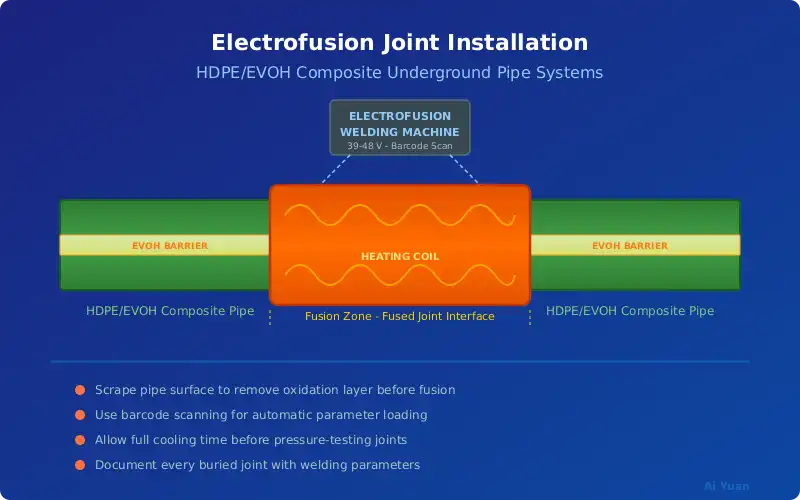
The fusion surface must be clean, dry and freshly scraped, and no shortcut replaces any of those three. Oxidation and dust are thin, invisible and fatal to fusion quality. A scraper that removes a consistent layer, wipes that leave no residue and a marking pen to prove the scraped zone all cost seconds. Crews that skip them save two minutes per joint and borrow trouble for twenty years.
Alignment and restraint during the cycle
| Habit | Why it matters | What skipping it costs |
|---|---|---|
| Full-depth scraping of both pipe ends | Removes the oxidized skin the fusion cannot bond through | A cold joint that holds on test and weeps in service |
| Clamping before the cycle starts | Holds pipe and fitting in line while the material melts | Movement during fusion creating a weak, offset joint |
| Pipes supported at equal height | Keeps the gap even around the full circumference | Fusion pressure concentrated on one side |
| No touching or loading during the cycle | The melt zone is forming; movement ruins it | Micro-disturbances that never show until failure |
| Cooling time respected before release | The joint reaches strength only after full cooling | A joint stressed while still soft |
A routine that fits real site pace
Fast crews are not the ones rushing cycles; they are the ones whose routine never stops to think:
- Cut the pipe square and deburr the ends;
- Mark and scrape the full insertion depth on every end;
- Wipe clean, dry-fit the fitting and clamp everything in alignment;
- Run the fusion cycle exactly as the control box dictates, hands off;
- Allow full cooling under clamp before moving or testing the joint.
Recording the cycle, not just making it
Most fusion control boxes log the cycle parameters, and the best project habits capture that log against the joint location. When a joint question arises years later, the record answers it without excavation. A handwritten note of joint number, fitting batch and cycle result turns the installation from memory into evidence, and costs almost nothing during the work itself.
Frequently asked questions
Can a joint be re-fused if the cycle was interrupted?
A cycle interrupted mid-melt has already formed a partial joint of unknown quality, and the safe answer is to cut out the fitting and start again on fresh pipe ends. Restarting the same fitting risks a fused shell around an unreliable core, which is the worst kind of joint to leave buried.
How much scraping is enough?
Enough to remove the full oxidized layer over the entire insertion depth, which typically means a visible, even fresh surface with the original gloss gone. Under-scraping is the single most common cause of long-term joint failures, and it is invisible at test pressure.
Do fittings need protection during storage on site?
Yes. Fittings kept in open crates collect grit exactly where it does most harm. Keeping them bagged until the moment of installation, and never pre-scraping hours ahead, preserves the surface condition the fusion depends on.
Luoyang Wohong Petrochemical Equipment Co., Ltd. supplies double-wall composite fuel piping, fittings and electrofusion accessories for gas station and fuel depot projects. Contact us for pipeline layout review and product selection support.