
Short answer: seismic anchoring for a station storage tank is never just a tank job, because the moment the tank is held still, the buried composite fuel pipe that feeds it is asked to move differently. A tank retrofit that adds anchors, straps or base isolation changes how load travels into the connected piping, so the line needs its own restraint, clear standoff from the tank base, and verified joints. Treating the tank and the pipe as one seismic system is what keeps a retrofit from trading one failure mode for another.
Why the tank and the pipe are one seismic system
A storage tank and the piping that serves it move as a pair during ground shaking. If the tank is anchored and the pipe is not, the pipe takes the relative motion the tank no longer absorbs, and that motion lands at the fittings and transitions where the line meets the tank. An underground composite fuel pipe is flexible and tolerant, but it is still a physical connection between two masses that now behave differently. The retrofit only works if both ends of that connection are considered together, because anchoring one and ignoring the other simply moves the stress to the ignored end.
What tank anchoring actually restrains
Anchoring a tank is about stopping it from sliding, tipping or lifting under vertical acceleration, and the method depends on the tank type and base. Straps over the shell, hold down bolts at the base, or base isolation that lets the tank ride the motion all change how force reaches the pipe connections. Each method sets a different relative displacement at the tank nozzle, and that displacement is the number the piping design must absorb. The pipe seismic design guide shows how the line is matched to expected movement, and the tank anchor is what sets the movement the line must survive.
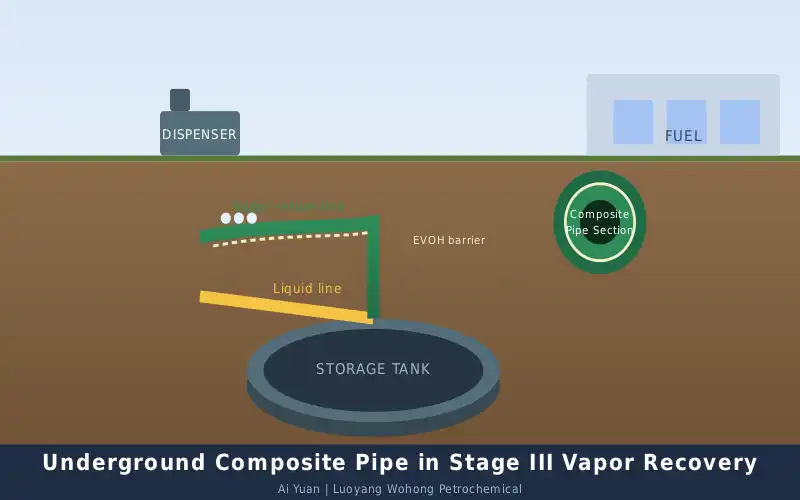
How a retrofit changes the pipe run
A seismic upgrade often means cutting into the existing line to add flexible connectors, relocating risers, or re supporting the run near the tank. That work is where most retrofit surprises start, because the buried composite fuel pipe was laid for a calm tank, not an anchored one. Re supporting the line close to the tank, adding expansion capability at the transition, and confirming the joint type can take the new range of motion are the steps that protect the existing investment. The pipe support and anchoring guide explains how the run is held steady between restraints, and a retrofit is the moment that restraint plan needs rethinking.
Where the pipe must stay clear of the tank
The ground right under and beside a tank base is the worst place to bury a fuel line, because that is where the anchor load, the settlement and the movement all concentrate. Keeping the buried composite fuel pipe out of the tank shadow, with a defined standoff and a clean bedding path, is what stops the line from being crushed or dragged by the very structure it serves. The standoff distance follows the tank foundation design, and it is written down during the retrofit rather than left to the excavator.
Restraint details that protect the buried line
At the tank, the line needs flexible transition fittings and enough unrestrained length to absorb relative motion without pulling on the buried run. Below grade, the pipe benefits from consistent bedding and restraint points that spread movement instead of concentrating it at one coupling. The table below maps each retrofit decision to what it protects:
| Retrofit decision | What it controls | What goes wrong if skipped |
|---|---|---|
| Tank anchor type set | Relative motion at nozzle | Pipe absorbs movement meant for the tank |
| Pipe standoff from base | Load away from the line | Line crushed or dragged by foundation |
| Flexible transition at tank | Absorbs relative shift | Coupling torn at the tank wall |
| Bedding and restraint | Even support under shake | Point load cracks the wall |
| Joint verification | Continuity of bonded line | Open joint hidden after backfill |
The pattern across careful retrofits is the same: every decision at the tank has a matching decision at the pipe, and the two are checked as one package.
Steps for a coordinated tank and pipe retrofit
A retrofit that protects both structures follows a short, disciplined sequence:
- Map the tank anchor method and the relative displacement it creates at each nozzle before touching the pipe;
- Set the buried line standoff from the tank base and keep the run out of the foundation shadow;
- Add flexible transition fittings at the tank so relative motion is absorbed above grade, not in the trench;
- Re support the buried composite fuel pipe with even bedding and restraint points that spread movement;
- Verify every joint and bond continuity before backfill, because an open joint is invisible once closed;
- Update the as built with the new anchor points and standoff, so the next crew knows what was changed.
The last step is what makes the retrofit durable, because a seismic upgrade that is not drawn is an upgrade nobody can inspect after the ground closes.
Frequently asked questions
Does anchoring the tank change the pipe design?
It does, because anchoring fixes one end of the connection and forces the other end to take the relative motion. The buried line needs flexible transitions and a standoff that keep that motion from landing at a coupling. Ignoring the pipe during a tank anchor is the most common way a retrofit creates a new leak risk.
Can an existing composite line be kept during retrofit?
Often yes, because a buried composite fuel pipe is flexible and tolerant, but only after the standoff, transitions and restraint are checked against the new tank movement. Keeping the line is cheaper than replacing it, provided the retrofit plan treats the existing run as a structure with its own seismic demands.
What fails first if the pipe is ignored?
The transition at the tank wall, where relative motion concentrates, and the nearest buried coupling, where load lands after the tank stops moving. Those are the points a seismic retrofit must design for, and they are the ones most often overlooked when the tank alone is the stated scope.
Seismic upgrades touch the whole fuel system, and the sister site explains how siting and clearances around station equipment protect the same site above ground.
Luoyang Wohong Petrochemical Equipment Co., Ltd. supplies double-wall composite fuel piping, fittings and electrofusion accessories for gas station and fuel depot projects. Contact us for pipeline layout review and product selection support.