
Most of the attention in fuel piping projects goes to the buried run, and then the dispenser island turns into a scramble. The tank side has its own requirements, but the dispenser side is where the pipe meets moving vehicles, daily servicing and safety shutoff hardware, all inside a small excavation. Planning this end of the line as its own sub-project keeps the island from becoming the schedule risk.
What lives in the dispenser pan
Under a typical dispenser sit the riser, a shear valve, flexible connectors and the transitions from buried pipe to equipment. Each of these parts has a purpose: the riser brings the line up, the shear valve closes if the dispenser is struck, and the flex connections absorb alignment and vibration so rigid joints are not asked to do a job they cannot do. Crowding them into a pan that was sized as an afterthought is a common and avoidable problem.
Why alignment matters more on the island
Buried runs can tolerate small direction changes made with fittings. The dispenser side cannot, because everything above the pan must line up with the equipment bolt positions. Forcing alignment at the last fitting puts stress into the assembly that shows up later as leaks or cracked housings. Planning the riser position to match the dispenser footprint, not just the trench route, removes most of that stress before it exists.
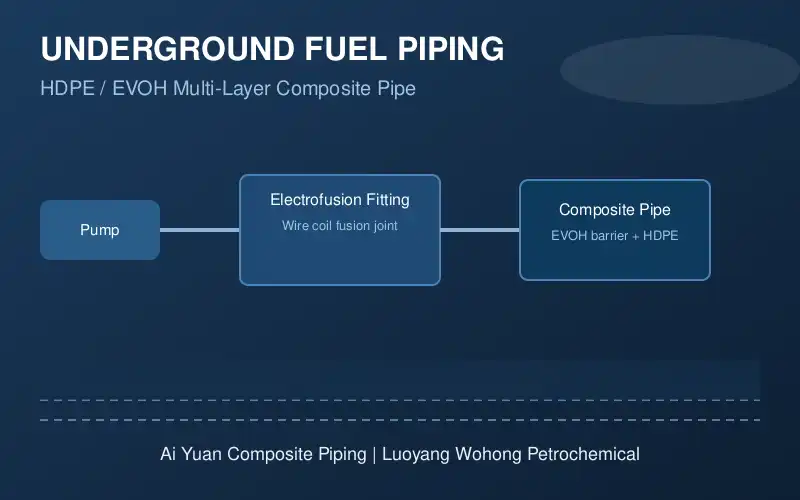
This is also where the choice between rigid and flexible connections pays off or backfires. Flexibility in the right place absorbs thermal movement and minor misalignment. Flexibility everywhere adds joints and parts that need inspection for the life of the island.
Shear valve placement is not negotiable
The shear valve only protects the forecourt if it sits at the right height and is mounted the way the manufacturer expects. A valve set too deep, or boxed in by piping that blocks its closing motion, reduces the protection to a formality. During planning, the pan depth, the riser height and the valve orientation should be confirmed together, not left to whoever assembles the island.
Planning sequence for the dispenser end
- Confirm the dispenser model and its connection positions early;
- Fix the riser location from the equipment footprint, not the trench line;
- Select shear valves and check their installed height against the pan;
- Decide where flex connectors go and where rigid joints take over;
- Verify service access: what has to be reachable during routine maintenance;
- Review the assembly with the island builder before the concrete is poured.
Mistakes that show up after commissioning
| Mistake | When it shows up | Prevention |
|---|---|---|
| Riser positioned from the trench route | At dispenser installation | Start from the equipment footprint |
| Shear valve boxed in by tight piping | During inspection | Check closing motion before backfill |
| Flex connector used as a permanent bend | Leaks months later | Align properly; flex absorbs movement only |
| Pan too small for the hardware | Every service visit | Size the pan with the parts list |
| No access for future replacement | First valve change | Plan access as a requirement, not a bonus |
Talking to the island builder early
The company that sets the dispensers and pours the island has its own sequence and its own tolerances. When the piping plan and the island plan are exchanged before work starts, the riser positions, pan sizes and valve heights can be agreed on paper. That conversation costs an hour and routinely saves a rework order.
Frequently asked questions
Can the flex connector be replaced with extra pipe fittings?
It can be done, but it moves all the misalignment into rigid joints, which do not tolerate it well. Flex connectors exist to absorb the movement and vibration that rigid joints cannot, especially at the dispenser where vibration is constant.
Does the shear valve need maintenance access?
Yes. It is a mechanical device with seals that age, and reaching it should not require dismantling half the island. Access planning is part of the pan layout, not a later addition.
Who decides the riser height?
The dispenser model and the shear valve installation requirements decide it together. Set it from the equipment drawings during planning rather than trimming pipe on site.
Luoyang Wohong Petrochemical Equipment Co., Ltd. supplies double-wall composite fuel piping, fittings and electrofusion accessories for gas station and fuel depot projects. Contact us for pipeline layout review and product selection support.