
Burial depth is one of those decisions that looks simple on a drawing and gets complicated in the ground. Too shallow, and the line sits under traffic loads it was never planned for. Too deep, and every joint becomes harder to reach, every leak test takes longer, and the excavation cost climbs for no engineering benefit. The useful answer sits in between, and it depends on what is above the pipe rather than on habit.
What cover actually protects against
Cover exists to keep surface loads away from the pipe wall and to hold the line stable against movement. At a fuel site the loads are easy to list: vehicle wheels crossing the forecourt, occasional delivery truck traffic, and the weight of slabs or equipment placed over the route. Each of these transfers force into the soil, and the soil spreads that force with depth. More cover means less of the surface load reaches the pipe, but only up to a point where extra depth stops buying anything.
How the route decides the depth
Not every run of a fuel piping system faces the same conditions. A line crossing under a heavy traffic lane needs more protection than a run inside a landscaped strip that no vehicle ever crosses. Splitting the route into load zones and assigning a depth to each one is a better use of excavation budget than applying a single deep profile everywhere.
Load zoning also changes the fittings conversation. A shallow run in a protected zone can be laid and inspected quickly, while the deeper sections concentrate the care: bedding, backfill compaction and joint access all get harder as the trench gets deeper.
Bedding and backfill do half the work
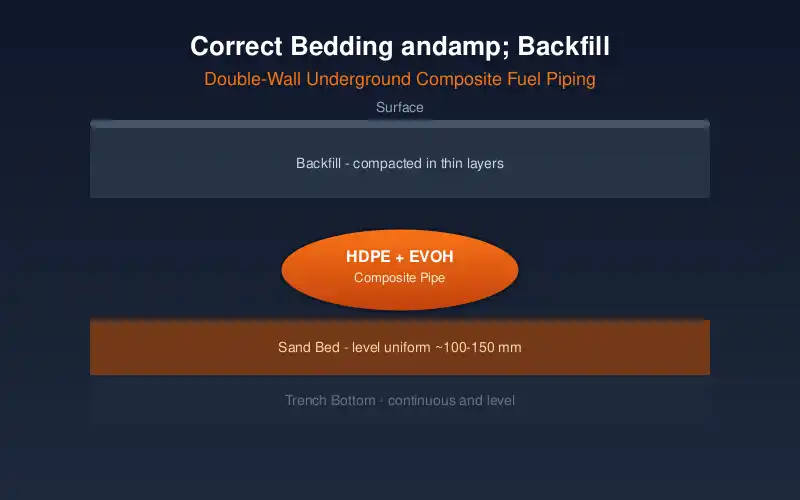
The pipe does not carry these loads alone. The material under and around it spreads the load and holds the line in shape. A trench with sharp stones in the bedding can damage a pipe that the depth calculation said was fine, and poor compaction can let the line settle after the surface is restored. The depth figure and the soil work are one package, not two separate items on a checklist.
Setting the cover requirement for a project
- Walk the route and mark every point where vehicles or slabs cross the line;
- Group the route into light, medium and heavy load zones;
- Assign a cover figure to each zone from the pipe supplier’s guidance;
- Check existing services before committing, because depth conflicts are cheaper to fix on paper;
- Specify bedding and backfill along with the depth, not as a separate note;
- Record the final as-built depths for every section during installation.
Common depth mistakes and their consequences
| Mistake | What it causes | How to avoid it |
|---|---|---|
| One depth for the whole site | Deep, expensive runs where shallow would do | Zone the route by load |
| Depth decided without checking services | Clashes found mid-excavation | Survey existing utilities first |
| Treating bedding as optional | Pipe damage or settlement after backfill | Specify bedding with the depth |
| Ignoring future site changes | Line left shallow under a new traffic lane | Ask about planned site upgrades |
| No as-built depth record | Later work risks striking the line | Log depth per section at install |
Working with the excavation crew
The crew digging the trench sees the soil conditions before anyone else. Briefing them on which zones carry which depth requirement turns them into an extra inspection layer rather than a source of surprises. When they hit a condition that does not match the plan, the depth decision can be revisited on the spot instead of after the surface is closed.
Frequently asked questions
Does deeper cover always mean better protection?
No. Beyond the point where surface loads are adequately spread, extra depth adds excavation cost and makes joint inspection harder without adding real protection. Depth should follow the load zone, not a habit of digging deep everywhere.
Can the depth change along a single run?
Yes, and it often should. A line that leaves a heavy traffic lane and enters a protected strip can rise to a shallower profile, as long as the transition is gradual and the bedding is maintained.
Who confirms the depth is right before backfilling?
Ideally the same person who set the requirement, or a supervisor working from the zoned drawing. Checking depth at the trench against the drawing takes minutes and prevents arguments later.
Luoyang Wohong Petrochemical Equipment Co., Ltd. supplies double-wall composite fuel piping, fittings and electrofusion accessories for gas station and fuel depot projects. Contact us for pipeline layout review and product selection support.