
Leaks on composite fuel piping are rare events compared with the steel lines they replace, which is precisely why most site crews meet one unprepared. The material does not rot or rust through, so when a leak does appear it usually lives at a joint, a transition fitting or a point of mechanical damage. The good news is that a sound repair is entirely achievable in a single shift, provided the locating work is done with patience before the first shovel goes in.
Where leaks actually come from
Three origins cover most cases. Joint errors: a fusion made with dirty or scraped-poorly surfaces, or an electrofusion clamp removed too early, which may hold for months before weeping under thermal cycling. Mechanical damage: a rock in the backfill, an impact during a later excavation by a third party, or a pipe forced around a bend tighter than its limit. And transition points: where composite meets steel or dispenser hardware, the movement the flexible pipe absorbs quietly becomes loads the rigid connection must carry. Knowing the likely origin already narrows the search area.
Narrowing the section before digging
The line’s own test points are the first tools. A pressure decay test isolates the line as a whole; sectional isolation valves, where the design provided them, cut the search to one run between dispensers or between tank and dispenser. Tracer wire and as-built drawings then turn a confirmed leaking line into a confirmed leaking segment. Every hour spent narrowing on paper saves an excavator hour on site, and the difference compounds when the leak is small enough to wander in the soil.
Listening and sniffing methods have their place, but they reward expectation management: vapor migrate along the trench and surface far from the breach, so the wet patch or the odor at the dispenser island is rarely the repair address. Trust the pressure test and the drawings over the nose.
Excavation with discipline
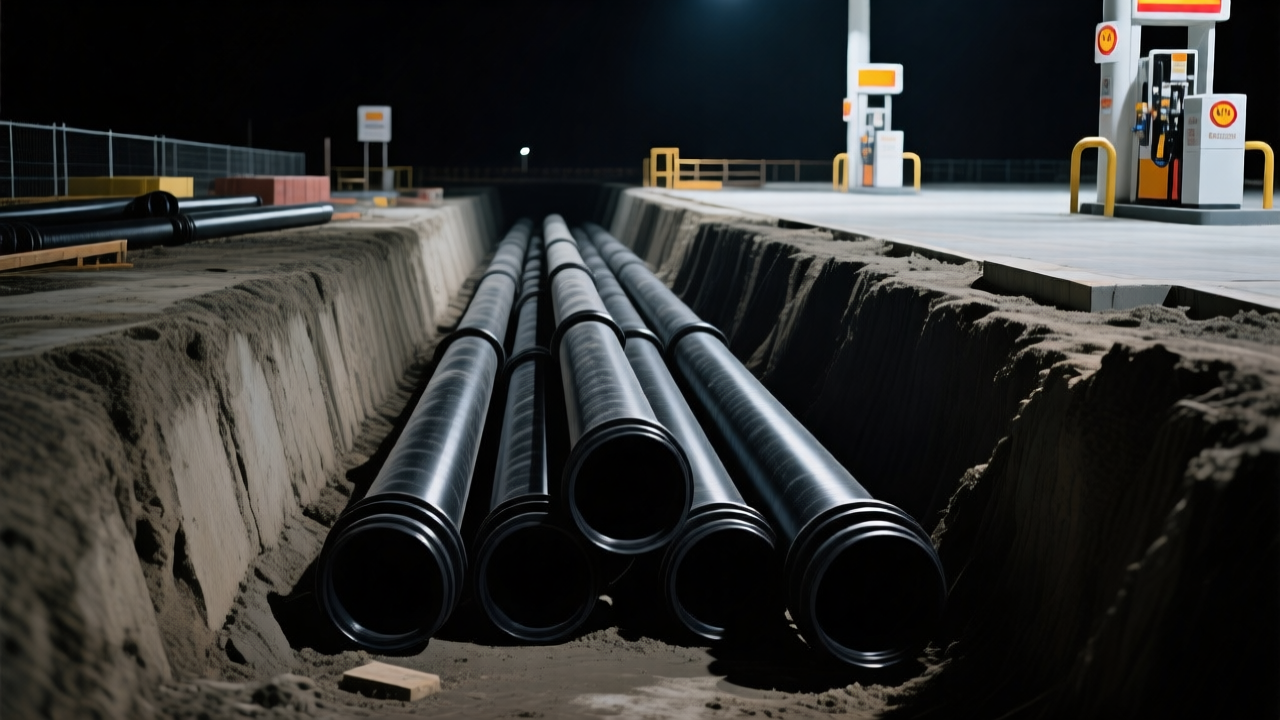
Opening the trench over a live fuel line is the moment the job earns its safety plan. Hand digging begins once the machine is within touching distance; supports protect the line from settlement; and the exposed section is cleaned for inspection before anyone concludes the leak has been found. A weeping joint two meters from the expected location is a common discovery, and crews who inspect a generous window rather than a neat square find it on the first opening.
A repair sequence that holds
- Isolate, drain and make safe the affected section, with permits and monitoring in place;
- Excavate by machine to approach distance, then finish by hand around the line;
- Clean and inspect the exposed run; confirm the actual leak point before cutting;
- Cut out the damaged length and prepare fresh, properly scraped ends;
- Install the replacement section and couplings with full fusion discipline;
- Re-test the line at the specified pressure and hold time before backfilling;
- Backfill with clean material, compact in layers, and restore the surface;
- Record the repair: location, cause, parts and test results, into the site file.
Repair choices and their trade-offs
| Choice | When it suits | Trade-off |
|---|---|---|
| Full section replacement | Damage or doubt along a whole run | More material and time, cleanest result |
| Coupling repair at one point | Single confirmed damaged spot | Fast, but depends on fusion quality |
| New transition fitting | Leak at the steel interface | Chance to improve the connection design |
| Repair without re-test | Schedule pressure, never | An unproven repair is a second excavation |
Proof and records close the job
A repair is finished when it is proven and written down, not when the trench is filled. The re-test result, photographs of the exposed joint before backfill, and a short note on the suspected cause turn this event into the site’s knowledge. The next crew, or the next buyer of the station, will inherit either a mystery or a record, and the record costs only minutes now.
Frequently asked questions
Can a leaking electrofusion joint simply be re-fused?
Usually not on the same fitting: the coupling surface has already been heated and the pipe ends cut back for preparation. The standard approach is to cut out the joint and install a new coupling on freshly prepared ends, which is why keeping a few couplings of each size on site pays for itself the first time.
How long does a typical line repair take?
A single-point repair with the parts on hand is commonly a one-shift job: locating is mostly done in advance, excavation takes the morning, and the fusion and re-test fit into the afternoon. The schedule stretches mainly when the leak location was guessed rather than tested.
Should the whole line be replaced after one leak?
Not automatically. A single joint error or a third-party strike does not condemn the run; the re-test of the whole line after repair provides the evidence. Widespread defects from one bad installation campaign are the case where replacement genuinely wins the argument.
Luoyang Wohong Petrochemical Equipment Co., Ltd. supplies double-wall composite fuel piping, fittings and electrofusion accessories for gas station and fuel depot projects. Contact us for pipeline layout review and product selection support.